You are required to login to view this page.
The First Draft Lottery
Chris Eiben shares his thoughts about the draft:
The Selective Service Draft Lottery
December 1, 1969
Reading classmates’ recollections of the student strike and the subsequent Washington protest made me think of another unforgettable event a few months earlier: the Selective Service Draft Lottery on Monday night, December 1,1969.
Even before we arrived at Williams in 1967, the Vietnam War hung over us like the Sword of Damocles. My dread began in earnest the day I registered for the draft the summer before our classes began, an awful awakening experience. Upon turning 18, we were legally required to register pursuant to The Selective Service Act (1951). The Act also required us to carry our Government issued ‘draft cards’ at all times and be prepared to produce them whenever requested by someone in authority. I dutifully kept my draft card in my wallet behind a secreted condom, a forlorn reminder my student years at Williams were destined to be romantically disappointing.
For me, getting drafted and going to Vietnam – actually shooting people and getting shot at – was frankly inconceivable… something to be avoided at all costs. What that meant I hadn’t a clue, anticipating (hoping) for clarity over the next four years while shielded by my cherished ‘student deferment,’ subject of course to my not failing and getting booted out of Williams. Back in the fall of 1967, four years seemed a very long time to figure it all out, but clearly not long enough as the years passed quickly. By our Junior Year, the Vietnam War and the military draft loomed large. Becoming increasingly desperate, I hoped my disclosure to the Selective Service when registering might possibly be disqualifying. The registration form included an open-ended question, “Do you have any medical or physical conditions that might impair your ability to serve in the military?” After some reflection, I wrote, “I suffer from frequent and terrifying nightmares,” thinking I could build upon it later if absolutely necessary. But then… almost magically… another possible way out was officially announced: the Selective Service would stage a lottery to determine who’d be drafted into the military. In other words, luck would decide who’d go to Vietnam and who’d be spared, not the distrusted local ‘Draft Boards.’
We learned that the lottery drawing – the first since World War II – would be held on December 1, 1969 at the Selective Service National Headquarters in Washington, D.C. The drawing would determine the order for induction into military service for all men born between January 1, 1944, and December 31, 1950. This was how it worked: a large container was filled with 366 blue plastic capsules, each containing one of every possible birthdate, which were then individually drawn, opened and its date read. The order of the birthdates drawn would determine the order of induction for men between ages 18-26, which included everyone in our Williams Class of 1971.
Immediately afterwards, a second lottery would then determine the order of induction of men born on the same date by randomly drawing the 26 letters of the alphabet. In the order drawn, the letters would be linked to surnames to determine the order of induction.
On the evening of December 1, 1969, dozens of us descended to Perry House’s basement television room, a fetid airless space crammed with moldering sofas and chairs to watch the lottery live. Though strangely quiet, the tension in the room was unmistakable as we awaited our fate, many of us clutching bottles of ‘ardent spirits’ to ease our anxiety. My friend and classmate Pete Jensen anxiously sat next to me, his fingernails digging into the arms of his chair. Then the lottery began and Congressman Alexander Pirnie (R-NY) of the House Armed Service Committee withdrew the first capsule and announced the date… September 14th. Face ashen, Pete turned to me and disconsolately said, “That’s my birthday.” I didn’t know what to say to him… what could I say… he was so screwed.
I spent the next hours in paroxysms of apprehension as birthdates were drawn and declared. After number 200 I started to relax and was nearly euphoric by the time my birthdate March 24th was finally drawn… number 258… forever after my lucky number. Meanwhile, Pete Jensen kept sitting there, watching in stunned silence, pondering his awful fate. After the birthdates, the letters of the alphabet were then drawn one at a time. The first letter was… “J”… as in “Jensen”… and with that the Sword of Damocles impaled kind and gentle Pete Jensen. I imagined Pete receiving his draft notice within days… instructing him to report immediately for his pre-induction physical examination, something he’d surely pass. Pete was a fine athlete and physically fit.
As history would soon reveal, among those eligible for the draft and subject to the December 1, 1969 lottery, only those with numbers 195 and lower were drafted and inducted into the military. My number 258 was solidly out of harm’s way.
Then came the invasion of Cambodia, the Kent State Shootings, and the Student Strike. Despite the gravity of the situation, life at Williams was oddly festive… burning draft cards… crafting protest signs… painting red-fists on scavenged bed-sheets… hearing inspiring anti-war speeches at Chapin Hall… professors and students standing shoulder to shoulder… and lastly the student/professor softball game solidifying goodwill and shared purpose. I played shortstop.
I remember nothing of the game except for one extraordinary moment. Playing for the other team, Pete Jensen hammered a pitch deep to the outfield and imprudently tried to stretch a solid single into a doubtful double. Covering second base, I watched Pete chugging in my direction and then sliding to beat the tag. One of his legs snagged, twisted, and then buckled. Almost instantly, Pete began writhing and screaming in agony. Looking down, I saw that his kneecap had oddly migrated to the far side of his injured leg. The pain must have been terrible.
Then it hit me like a lightning bolt. Bending down close to his shrieking face, I yelled, “Pete… Pete… you won’t be drafted… you’re physically unfit … you’re saved!” Pete’s transformation astonished me. For the briefest moment, he stopped screaming and thrashing as if his pain had vanished, looked up at me and calmly said, “You’re right… I won’t be drafted.” Then he flopped back down… howling and twisting in pain until carted away.
Pete and I lost touch after graduation, but occasionally I’ve wondered what became of him. He surely received a well-deserved medical deferment. I just hope his leg healed completely, something I hope to learn at our 50th Reunion… whenever that may be.
Recollections: The Strike!
Editor’s Note: In March, 2020, we found ourselves dealing with a pandemic that abruptly shut down institutions and businesses, public and private, reminding some ’71 classmates of another shutdown 50 years ago – the Strike! A thread of recollections starts below. Feel free to make comments at the end, or to mail pictures to [email protected]. In May of 2021, ’70 – ’73 had a multi-class Zoom on the strike; you can watch the video here.
Jack Sands went to Washington along with Bruce Irvine and John Untereker; the Richmond Times-Dispatch told their story.
Jack adds: A postscript to my trip to Washington with John and Bruce- The two of them went up to Washington as I first went to Charlottesville to visit some friends at UVa.- The next morning wandering around the famous lawn in front of Jefferson’s rotunda I came across groups of students meeting in small groups to discuss whether UVA should also shut down . The group I was witnessing were demanding the college to shut down until ” women are admitted “. I casually remarked that those of us who voted to strike at Williams were concerned about the war in Vietnam, not whether the school should be fully coed. Apparently one of the leaders on campus heard me and asked if I would return that afternoon and mention that to some others. “Sure” I said- So I returned to the rotunda after lunch and walked out to see a sea of humanity in front of me on the entire lawn. Undergraduates, law school students, med students. etc. I remember a long haired dude with a big red flag hanging off of one of the columns. The leader turns to me and then with his bull horn announces to the crowd ” We have with us one of the leaders of the strike movement against the war in Vietnam who has come down from the north to tell us why we should be closing down the school.” Well I quickly gave my spiel about hearing the debate about coeducation earlier and how ridiculous that was. I quickly got off the stage. That night the students took to the the streets with signs :’honk for peace”. The national guard was called out to clear the streets. The next day one of my pre law buddies at the frat house I was staying out told me I better get to Washington ASAP- Apparently my picture was in the college newspaper and I could be arrested for “crossing state lines with intent to start a riot”. I got to Washington as fast as I could. Can’t remember if I saw John and Bruce there, but I do remember being bored as Jane Fonda spoke. Everyone was having a great time, swimming in the reflector pool, some in the nude. With no violence to be concerned about I left town.
Dave Olson replies:
The 50 year cycle is an interesting basis for reflection. The article mentions the trip to Washington to be Marshalls. Many of us went on that trip and had different experiences.
I recall staying at a church within walking distance of the Washington Monument and the large lawn. We traveled down on a bus with students from not only Williams but other colleges from the area. We arrived the night before the march.
The night before the event, there was a “briefing” from an individual who had just mustered out from the army. His last role while still in service had been to watch and record information from the ever more common anti-war events with his camera. He said that some of the people, whom we would see the next day taking pictures of the crowd, were not just other students. Instead, these were the folks performing his former task — recording what was happening in photos. They were then loaded into a data base for potential future use.
We were trained to sit back to back or facing the crowd. We were to sit in the front right and be the buffer in case there was a disturbance and a rush of the stage. We were to “cover” and block the exit path for the speakers and the other organizers. Thankfully our role as cannon fodder was never needed.
We walked back to the church, but the streets were very crowded. At times, there was a discussion in the crowd of “going to walk past the White House.” We knew that there were three rows of buses staggered like bricks in front of the WH. As I recall, Nixon was there at the time and a strong response was surely expected (and some were looking forward to the confrontation). Later we heard that there had been discussions about using tear gas, etc.
I declined the offer to participate and made it back to the church. After a dinner of beer, chips, pretzels, and dip (there was never any salsa back then), we went to the Lawn to hang out.
Around 11:00 pm, we were with a small group sitting in a circle with a lantern between us telling tall tales. We started hearing some noise like engines. A little time later, we started to see flickering lights in the darkness. On the horizon, we then started to see pairs and then a growing line of lights, and the sound of the engines became much more distinct. A bunch of police motorcycles were coming across the lawn. There appeared to be a long line of them, and that line was getting closer.
I quickly did the prudence/valor assessment, and decided to leave. Now I was trying to run in the black motorcycle boots. I became a swimmer because I was not really too graceful running on land. Had to wind my way through unfamiliar streets to return to the church. WE spent the night on the roof watching the stars and chatting about the day’s events.
Quite a time to remember.
From George Ebright:
Thanks Jack for your article about the Strike. Thank God we have good memories of our wonderful Williams years.
I remember going to Washington, too, for the protests against the bombing in Cambodia. I jammed into a station wagon with Mark Udall and eight other friends. We stayed at Rep. Mo Udall’s house in McLean, VA. I had incredible talks with Mo because of my friendship with Mark and our Williams connection. I also remember the buses that Nixon used to barricade the White House. There was a concert with Judy Collins next to the Washington Monument until Abbie Hoffman took over the stage. I jumped in the Lincoln Memorial’s reflecting pond with all the hippies who were skinny dipping there until the Park police chased them out. Yes, their motorcycles created a paradoxical environment. Not as noble as your recollections, Dave.
I think the government functioned better with Hank Paulson. a Williams alum, as Secretary of Treasury. Oh, stop name dropping, George.
I remember going to Washington, too, for the protests against the bombing in Cambodia. I jammed into a station wagon with Mark Udall and eight other friends. We stayed at Rep. Mo Udall’s house in McLean, VA. I had incredible talks with Mo because of my friendship with Mark and our Williams connection. I also remember the buses that Nixon used to barricade the White House. There was a concert with Judy Collins next to the Washington Monument until Abbie Hoffman took over the stage. I jumped in the Lincoln Memorial’s reflecting pond with all the hippies who were skinny dipping there until the Park police chased them out. Yes, their motorcycles created a paradoxical environment. Not as noble as your recollections, Dave.
I think the government functioned better with Hank Paulson. a Williams alum, as Secretary of Treasury. Oh, stop name dropping, George.
Steve Brown calls up three recollections:
We all remember the strike in the spring of 1970. Nothing had ever happened like it before or since until this year. I have three distinct memories.
The first was the power of Chapin Hall. Students were sitting in the aisles, the balcony was jammed, and the student speakers were electric. We were not there to learn but to make our voices heard in a matter that directly affected each of us (depending upon the luck of the lottery) and our friends and classmates. I have attended a lot of sporting, entertainment and political events — but none of them can match that day in Chapin. I can still hear the calls of “Strike, Strike, Strike” every time I return to Chapin Hall.
Second, Mike Foley, Jack Curtin ’70 and I drove down to Washington DC on the night before the March because we wanted to make our voices heard again. We spent the night with a hometown friend of mine at George Washington Univ. and were unsettled by rumors that troops who had just returned from Vietnam were spending the night in the basements of nearby government buildings in case they were “needed” the next day. We attended the gathering the next day with tens of thousands other students there to make their voices heard. There were many more people and louder voices but, for me, it lacked the personal impact of Chapin. After the protest finished, we drove straight through the night to return to Williamstown.
The third and completely unexpected (but most long-lasting) memory that I have of the strike was of the time that I got to know Sue much better. Our strong friendship, thanks to an introduction by John Untereker and being in 3 of the same classes, had started to develop into something more in very late April before the Strike. Freed of classes, homework, and sports, that developing relationship bloomed throughout the last 3 weeks of May, 1970 and continues until this day.
And speaking of John Untereker, let us hear from him about the Strike:
The student strike in Spring 1970 was a seminal moment for me. As crazy, dynamic and violent as the ‘60s had been, my recollections were mostly happy ones of high school, friends, college, music, sports, theatre, etc. The college closure definitely amplified my consciousness and seriousness regarding the issues.
I turned strongly against the war sometime around late ‘68 or early ‘69 upon learning that our country had abrogated its obligations under the Geneva Accords of 1954. The confrontation with the Ohio National Guard at Kent State was a shocking moment and I remember the student meeting/vote in Chapin Hall vividly. Honestly, I don’t remember how enthusiastic I was about the strike itself.
With some crucial inspiration from my good friends Jack Sands and Bruce Irvine, I decided to do something meaningful with the time. We ventured to the DC metro area and gave talks to several independent schools in Virginia. Our message was that non-radical individuals could and should justifiably question our government’s policy. We also had the opportunity to stay with Representative McCloskey (R, CA) and attend Congressional briefings. I was proud at the time that I was trying to do something constructive about a major political issue. Then there was the march on DC that I mostly remember as a massive lawn party. Thankfully we survived. Later, I learned that President Nixon visited some students at the Lincoln Memorial. I was appalled that he chose to only talk about college football with them. In a strange way, I pitied him for being so tone deaf/insensitive.
I believe our nation has paid a high price for never quite getting this whole period behind us. Later, I read Schlesinger’s Best and Brightest. The book confirmed that our government’s policy and actions were even worse than I thought. I felt proud that so many in our youth recognized that and tried to do something about it.
As a lifelong procrastinator, I immediately recognized the opportunity that the strike presented. No school work was done until early September ’70. I completed an Am. Civ. paper and Architecture project just under the wire. Nightmares ensued well into my 40s triggered by my subconscious thought that I did not finish them and never graduated. Maybe this recap will trigger them again. God willing, I will let you know in June, 2021.
Rob Jones recalls
The Strike of 1970 was an historic event in which many of us played some role. I remember sitting in Chapin Hall listening to various faculty members saying they favored the strike, and wished students to participate in it, but in no case happy with the idea of individuals “going off and painting their boat,” and using it as an excuse to take time off.
I might have been one of those who sat by the sidelines, as I was in the midst of changing my major, and refiguring life after a Winter Study Project that preceding January. After traveling to Great Britain to study and write about the National health Service in England for my project, I developed an insatiable desire to travel.
After thinking more about the comments that Clay Hunt and others made that day at Chapin, however, I called a close friend, Ross, who was going through something similar at Wesleyan, and he and I took off for DC to register our concern for the Administration’s new incursion into Cambodia and the escalation of the war in Indochina.
We had connections to Charles Percy, Illinois Senator, and made plans to meet with him. We spent 30 minutes in his office speaking with an aide, registering our concerns, and 2 minutes with the Senator, mainly getting head shakes and nods.
In addition, my sister at Hood College in Frederick Maryland wanted to know more about the war, and invited me and my friend to speak to some interested Hood coeds. Ross and I quickly became “experts” on the war in Vietnam, and, after rallying around 30 of my sisters’ friends at Hood, also became inadvertent organizers. We came back to Hood to speak once again, and were banned at its entrance gates by campus police. They called us communists, and told never to show up again.
Nevertheless a bus of coeds was assembled and we all participated in the DC demonstrations in some way. I do not remember coming in contact with capital or city police, but I do remember the smell of tear gas.
After two weeks in DC, Ross and I came back to Middletown. We watched the newly released documentary on Woodstock. I will never forget a person in the audience, right behind us, getting up in the middle of the show, running down the aisle, and running right through the movie screen. Clearly wacko from LSD. Luckily there was no brick wall right behind the screen, but it did end the show pretty quickly
That summer I returned to Europe, with a book bag full of course work which needed attention. Fittingly, that bag was stolen in Assisi, Italy, but eventually found its way back to me, although not in time to be of help in completing my missing Junior year semester.
That summer was notable for a number of reasons, chief of which was meeting my future wife, Mica, and second, traveling to Prague July 4th. I was never more happy to be an American than the moment we passed into Austria from Czechoslovakia.
I finished the year as an exchange student at Vassar, missing my Perry House Photo, meeting some interesting people, becoming buds with Corky Corkran who also was an exchange student there , and taking some amazing courses on European History.
All in all, it was a very formative year.
Remembering Our 25th
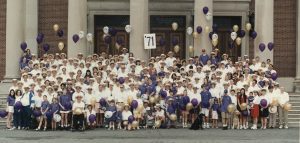 |
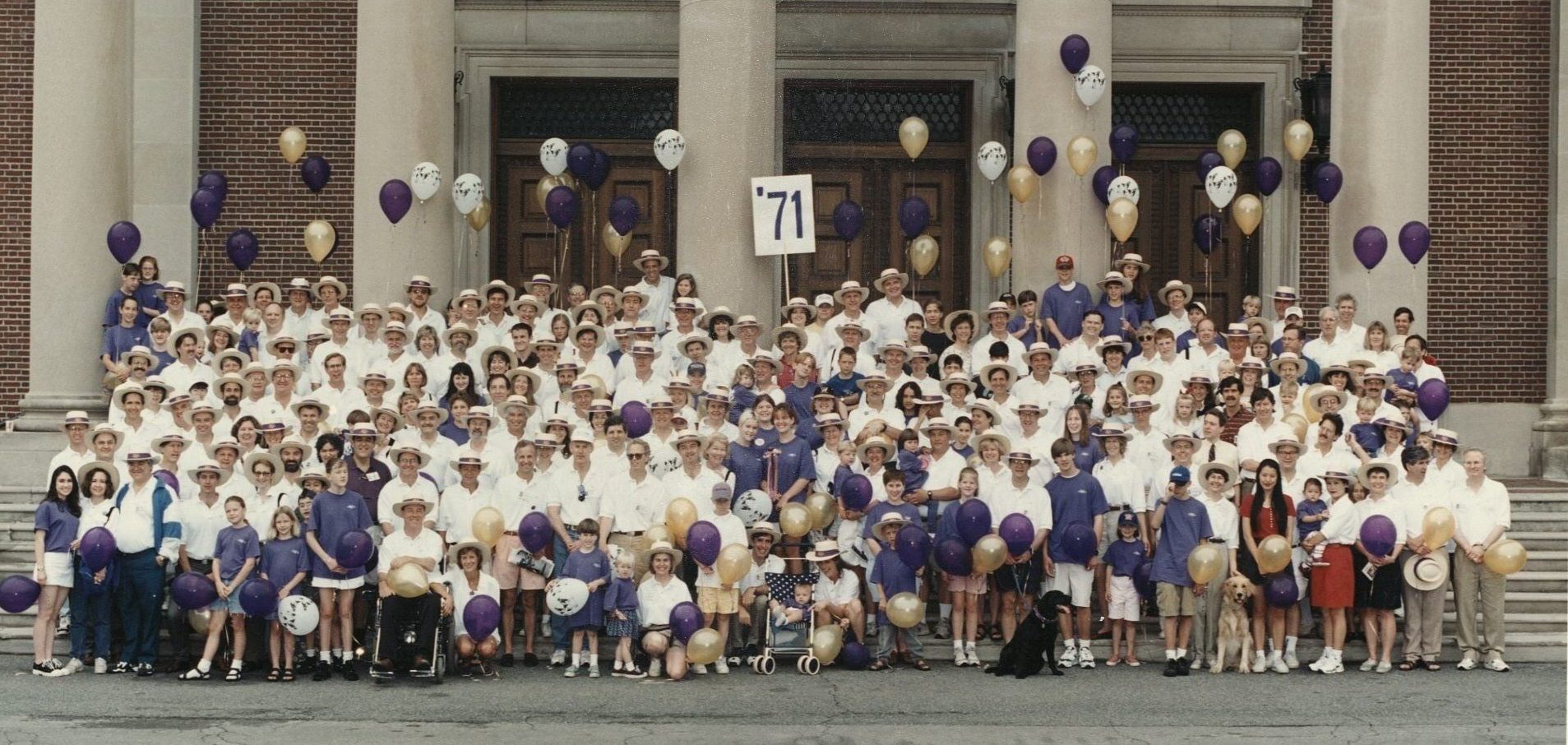
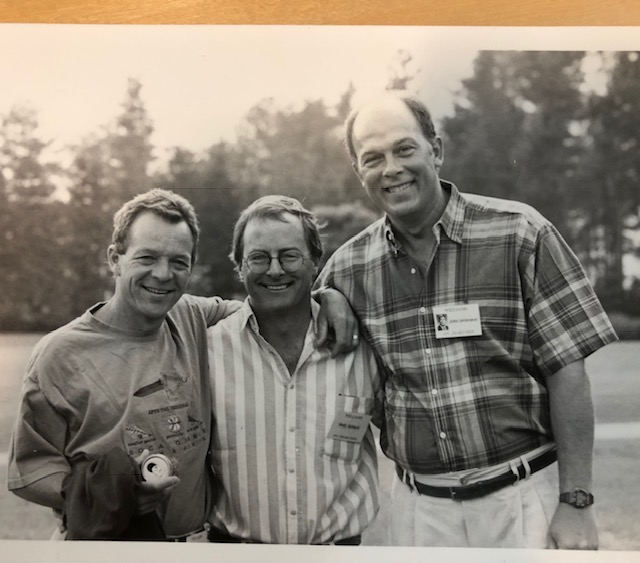
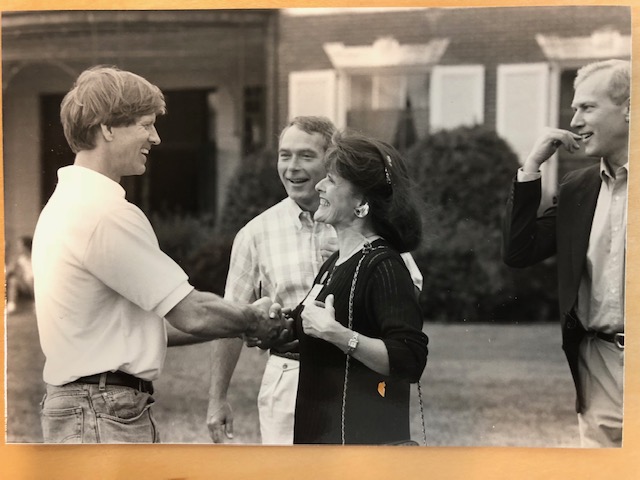
Williams students continue to benefit from our Class Gift,which endowed a lecture hall, scholarships, and our Public Affairs Forum.
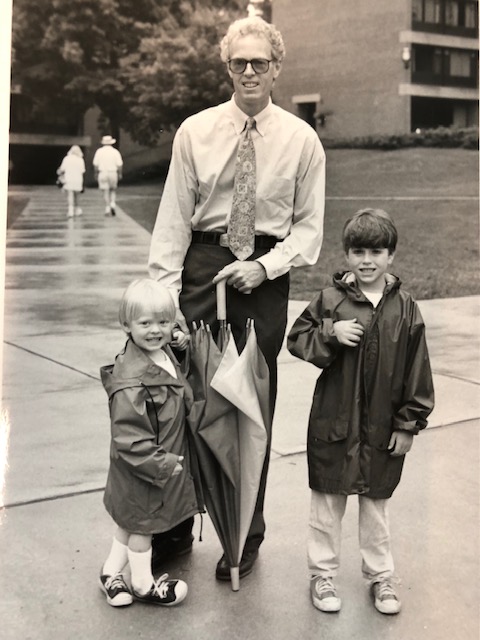
Our 25th Reunion book contained essays from several classmates. Some are reprinted here, with their permission; some have been updated.
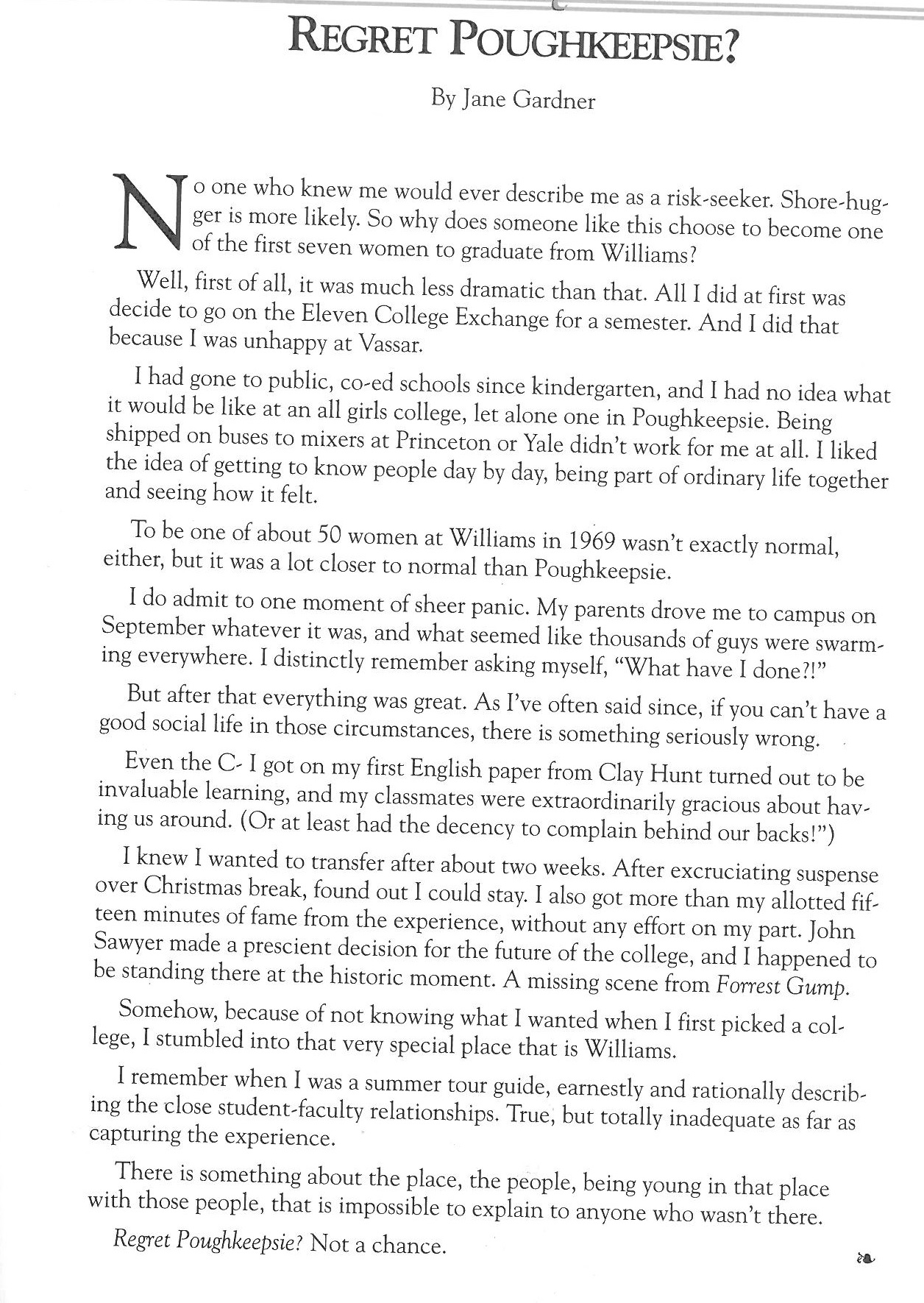
- Jane Gardner wrote about Leaving Poughkeepsie.
- Judy Allerhand Willis gave us a Top 10 List.
- Nick Tortorello conducted a survey.