An Uncomfortable Half-Century

Steve Brown sent the following to the class after the airing of Paul Lieberman’s new documentary “An Uncomfortable Half-Century” about Prof. Gaudino, his legacy, and the Gaudino Fund at age 50:

Dear Classmates and Friends/ Family of ’71,

       Thank you to the 60 classmates who either registered or appeared to watch  Paul’s showing of 4 chapters of his documentary of “An Uncomfortable Half Century “ followed by a Q&A  with Ed Berger (former Williams Prof. and Gaudino scholar) and Prof. Magnus Bernhardsson (current Prof. at Williams and also Gaudino Scholar) about the  current status of uncomfortable learning at Williams. It was spectacular.  For those of you missed it or were unable to stay for the entire program,  here is the link to the Dec. 2 program. An index to the program is attached at the bottom of this e-mail so you can choose quickly  what you want to see.  Here is the link:  Uncomfortable Half-Century_20251202_Speaker.mp4 – Google Drive

For everyone,  below is the just-posted YouTube version of the entire film, which you can view start-to-finish or by sampling the segments as you wish. 

 For “An Uncomfortable Half Century,” click this link:   https://www.youtube.com/watch?v=5pyu1lBeWZU

 As mentioned during the Zoom, this documentary in effect was a sequel to Lieberman’s film completed years ago, “Mr. Gaudino,,” on Robert Gaudino’s extraordinary life and tragic death, both shared intimately with the college community during our time there. If you’ve not yet seen that earlier film, here’s the link to “Mr. Gaudino”:

https://www.youtube.com/watch?v=XGrXPhu60zw

 Finally, on a topic close to the experiences of the classes of ’71-’74, here’s his video history of “The Pioneers,” the colorful (and brilliant) women who launched co-education at Williams. Enjoy:  50th Reunion Recap – Williams Class of 1971

INDEX to Dec. 2 session:

  0:00 – Introduction( can be skipped)

  4:00 – Paul introducing program

  7:53 –  Uncomfortable in Cairo

  21:30 – Uncomfortable Freshman

  32:53- 36:55 – SKIP – technical difficulties

  36:59  — Uncomfortable Creativity ( highly recommend – about Ed Berger as Gaudino Scholar)

  54:40 – Uncomfortable Behind Bars and the Human Library ( highly recommend about Magnus Bernhardsson as Gaudino Scholar)

  104:07-128:07 – Paul’ s Discussion with Ed and Magnus about current status of uncomfortable learning at Williams and higher education in general – highly recommend

BTW – my apologies to all of you who attended the Dec.  2 session for the technical difficulties in showing the videos. Unanticipated internet issues which should have been anticipated. My bad.

Huge thanks again to Paul for his wonderful work.

Best, Steve

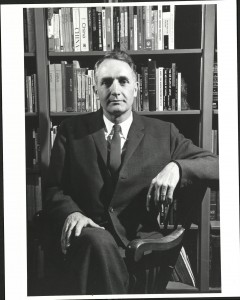
Larry Beals

Rob Farnham shares some thoughts:

It was an instrument utilized during his habit of hiking the Adirondacks in and around Keene Valley, NY, the summer haunt of William James. He brought it to my attention after a tutorial session on James our Senior year. The unit was a sophisticated compass able to be fastened on a tripod and essentially used to site boundary lines, as well as, provide ordinary bearings. I knew he hiked. He asked if I wanted to buy it as he did not utilize it much. I asked, “How much?” and he replied,” $15”. Even in 1971 it was worth multiples of that and I said , “Yes”. It was not the money he desired, but this offering enabled him to share something of mutual interest (hiking) while retaining a respectable relationship between student and professor.

Larry Beals was like that. Tradition oriented and a caring man who lacked the narcissism of a high-profile professor at an elite school. You would not think he was captain of the track team at Williams in 1929, his year of graduation, as his demeanor was anything but that of a competitive individual.

In December of 1986, I received a note from his wife, Betty, with a copy of the tribute given by Robert G.L. Waite (Williams History Professor, 1949-1999) in the Thompson Memorial Chapel on October 29th at the memorial service upon his death. I had not attended. True to Waite’s concise assessments, he stated Larry was “… a good man; a jolly companion; a thoughtful host; a loyal friend.” He went on to say, “He was an honest man. Direct without guile … and let you know where he stood on any issue.” Knowing Professor Waite as one not to sugar-coat the description of any individual, I find his sentiments true to my experience and what I believed Professor Beals to represent as a person.

Larry taught at Williams from 1933-1972 and upon retirement was named the College’s archivist. In the note, his wife remarked about my observation that James came before Santayana where they knew each other at Harvard ( Larry completed his doctorate there in 1933). She noted this was true and that as Larry got older he “philosophized” that Santayana was an old man’s philosopher and he really enjoyed him. She added, “In no other way did Larry show his age.” Indeed, I believe he was young at heart, a keen observer of the human condition and filled his life with the ruminations of his mind and the teaching of his students. Now, being an older man, I must take the time to understand what Professor Beals meant regarding Santayana, while also appreciating what an unexpected exploration Larry’s memory provides.

Fran Cardillo


John Ackroff has submitted the following:

December 16, 2020

On December 16, 1970, Fran Cardillo and I convened at some obscene hour in the morning to drive to Irwin Shainman’s house.  (Fran was staying in Brooks House — a different long story — so the rendezvous was not difficult.)  We were to drive Irwin and his family to New York for their sailing to Italy, where Irwin would spend his spring semester sabbatical leave visiting opera houses.  Fran and Irwin were close:  Fran had succeeded Irwin as Director of Bands, a post which Irwin gratefully relinquished.  The fact that Fran had a station wagon undoubtedly helped seal this deal.  I had taken Symphony in the semester that was ending, and I guess I got a good enough grade that Irwin and I were comfortable spending that much time together in close quarters.

We eventually arrived at the dock on the Hudson River from which Irwin’s ship was departing.  I don’t recall going on board to see them off, but I do remember the Italians who ran the dock operation tripping over themselves to do anything they could to make “Il Professore” and his family feel welcome, which also did not escape Irwin’s notice.

Once the Shainmans were settled in and the ship had set sail, we went to Brooklyn to visit Fran’s sister.  She made us chicken livers with onions (and bacon?) on toast.  And, mercifully, coffee.  (I don’t recall there having been madeleines, and probably wouldn’t have know what they were had there been any.)  There was a fair amount of discussion was about their brother Patsy (Pasquale), who was 2nd clarinet for the Boston Symphony Orchestra.

Fran decided that I should drive back.  Negotiating the Taconic’s “Wall of Terror” in the station wagon kept us awake for that segment.  I don’t remember what we talked about, but I remember opening the windows frequently to get some “fresh” (cold) air — it had been a long day.  We arrived back at Brooks House in time for the end of the NBC news, which in those days used the opening of the second movement of Beethoven’s Ninth as the exit theme.  A fitting close to the adventure, since it was Beethoven’s 200th birthday.  Episodic memory is an interesting phenomenon, and I am really good at placing events in time, but this coincidence makes this one easy.  I can think of other significant “moments” while I was at Williams, but can’t pin them down as exactly as this one.

But this was just one moment, albeit an extended one.  Fran is probably the person most responsible for keeping me sane during my years at Williams (although there are those who might argue about how successful he was).  Sitting in his office in Chapin listening to him struggle with various etudes was somehow relaxing for me.  Visits to the Captain’s Cabin for sombreros (once I looked old enough) gave us a chance to help each other unwind.


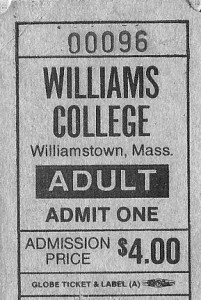
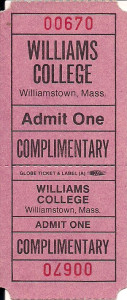
Fast forward 25 years or so.  I’d occasionally visit campus on fall weekends, usually for events related to fund raising, and would “happen” to drop by Chapin on Friday afternoon while the band was rehearsing for the following day’s half time show.  “John!” he’d say,  “Great to see you!”  Eventually, he’d ask if I would be going to the game the next day, and when I’d say that I was, he’d lower his voice, and in a conspiratorial manner, hand me a complimentary ticket, saying “Here, you shouldn’t have to pay to get in.”  This was a great savings, given the cost of admission in those days.     
 
I still have some of those tickets.  Great gifts come in small packages.  Fran gave me many.

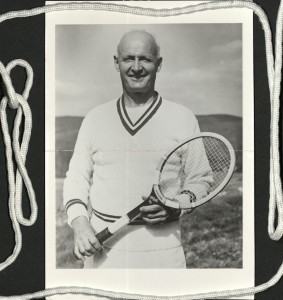
Kennedy Richardson Remembers Professor Stabler

Kennedy Richardson writes:

     Ever since graduation, I have always been known as, among other things, a Physics Major. Frequently with quizzical looks, people would ask “How did you ever get from Physics to managing an equity fund at Fidelity?” So to start near the beginning, when I arrived at Williams, I fully intended to major in Mathematics. Receiving advanced placement into sophomore math, I actually had to work for the first time and received a B+ in the course, my worst performance in math ever. I was devastated. Meanwhile at 8 AM on Monday, Wednesday, and Friday mornings, I was taking Physics 103 with “Papa” Stabler; a kindly, inquisitive, albeit somewhat absentminded, professor.  (My first Physics teacher at Belmont Hill was also someone I had loved and I was deeply honored to give the eulogy at his funeral.)  He would end each class with an experiment, always teaching, but occasionally with catastrophic results. Our favorite was the demonstration of the bell curve distribution with about 10,000 ball bearings. He forgot to place the trap in the bottom of the large glass container — no bell curve, but rather 10,000 ball bearings all over the floor.

     Class and assignments were always a wonderful exploration of some puzzle of the physical universe. What makes a rainbow? Why is the sky blue? And the first of Einstein’s famous thought experiments on relativity: Why do two men in two trains traveling at the same speed next to each other appear stationary? One day Dr. Stabler told us in passing that in Physics you would solve problems, while in Math you would discuss how you might address how one might solve a problem. By winter break I was hooked.  Incidentally, I cannot remember the name of my first Williams math professor.

     For four years, it was always figuring out a wonderfully complex series of puzzles about the physical universe. What is really going on here? What are the two or three key factors driving the phenomenon you were studying? In the end, there was always Dr. Stabler’s recommendation, “Please conclude with a few simple English words to summarize.” Vintage scientific instruction at a classical liberal arts college.

     Outside of class it was four years on the ski team. Fairly consistently on the winter carnival team but a very long way from number one (always John McGill). Plenty of hard work, lots of crashes, and always picking yourself up for the next race. All measured to 0.1 seconds. (More on 0.1 later.)

     By senior year, I loved my major, but knew a career in engineering or academics was not for me. The summer before, a fellowship at Brookhaven National Laboratory had convinced me. Next came Harvard Business School, and in 1973 on graduation, a career in investment management.

     Somewhat surprisingly, picking apart a stock was a lot like doing Physics problems. What are the two or three factors really driving the outcome? Get to a conclusion.  The few simple English words became two — ”buy” or “sell”.  With a diversified fund it was much more multivariable.  How do all the pieces fit together?  While unlike Physics, you could never ignore the human element in security prices.  All those humanities courses really did matter.  Starting a fund at Fidelity in 1985, I was once again measured quite precisely; to be exact, in increments of .01% of return, every 24 hours for 23 years. I have often joked that when they make you a diversified portfolio manager at Fidelity, they give you two things — a Bloomberg terminal, and a cyanide capsule, with one instruction: if one does not work, try the other.

     Managing a fund, like Physics, was a great intellectual game, perhaps the greatest ever invented. You also get to compete against some of the most aggressive and finest minds anywhere. As an added plus they even pay you. There is always a stumble or fall, just like sports (sounds like ski racing) where you have to pick yourself up, learn from the error and go on. I always liked to hire athletes with a great education, most notably my successor, Forrest St. Clair, Williams ’97, Biology major, baseball team.

     So today, I placed a couple of trades on the money I still manage for myself, went to physical therapy for my new right hip (so many happy memories of wearing out the old one) and over lunch I watched a thirty minute lecture from an online refresher course in quantum mechanics. This time, a first time for me, given by a very talented female professor from Purdue exceptionally good at “the few simple English words.”

     So that is how I got from A to B. Some things are constant, and some things change. See you in Oxford, at the 50th, or hopefully before.

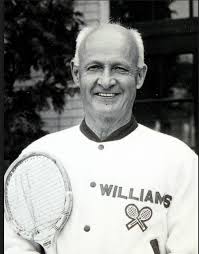
Remembrance of Professor Charles Compton

A REMEMBRANCE OF PROFESSOR CHARLES COMPTON

I got a “D” on my first chemistry hour test.  My future medical career seemed increasingly problematic.  Distraught and forlorn, I went to see Professor Compton to figure out what had gone so horribly wrong.  He saw me walking down the long hallway to the chemistry lab and knew immediately my concern.

As I got closer, he looked at me with a kindly twinkle in his eye and said: “Mr. Ruchman, fear not!  All is not lost.” 

With the kindness and concern of everyone’s favorite uncle, I went on to see him for private, weekly sessions to repair my obviously fractured knowledge of introductory chemistry.

As Department Chairman and as supervisor of all premedical students, he certainly had much better use of his time than devoting it to a potentially marginal “D” student like me.

Through his support and guidance,   I did tough it out, got a B+ for the semester, an A- for the year, and three years later a “thick envelope” from Yale Medical School.

My ongoing gratitude  to Professor Charles Compton. 

Mark C. Ruchman, M.D. (1971)    

Bobby Coombs

The following thoughts and photos were shared by Tim Murnane:

Bobby Coombs
2012

His 5 foot 9 inch, 160 pound frame was not what you would call “Major League.” His frequent appearances in scrimmages with his Williams College baseball squad usually resulted in an 0 for 4 for everyone and laughs of joy from the 60 something coach. He was the baseball man at Williams for almost thirty years. He was one of a kind, a character, an unforgettable man.

Raymond Franklin “Bobby” Coombs was, more than anything, a “Mainer.” Born in Goodwins Mills, ME in 1908, he spoke with a rich, northern New England accent and loved the ocean. He was a summertime fishing guide, chartering out of Perkins Cove in Ogunquit, ME, his offseason home.

To his players, Bobby was the coach, a friend and a mentor. He loved his players and relished being with them whether on the field, driving in school station wagons to away games or touring North Carolina for the annual spring training trip. Those two week trips, intended to get ready for the season in New England, required Bobby and his team to sleep in bunks at the visiting teams’ gym. Bobby was there with his boys every night, snoring away. He kept everyone awake, but, no one would wake him.

If asked about rules for his players, Bobby’s answer, always smiling, “Just one, no smokin’ on the bench.”

On away trips, when choosing a place for lunch, Bobby’s preference was always, in his perfect Maine dialect, “Let’s eat at the counta. It’s quicka.”

His ubiquitous corn cob pipe, which doubled, along with his scorebook, as a sign prop during games, might cause a stranger to misunderstand him. But, Bobby was not to be underestimated. A former Major Leaguer, graduate of Philipps Exeter Academy (after attending Kennebunk, ME High School) and Duke and a WWII veteran, Bobby was a man of intelligence, humor and humility. His words were thoughtful, straightforward and simple.

Bobby came from baseball royalty. His uncle, Jack Coombs, was a great Major League pitcher and longtime legendary baseball coach at Duke (1929-1952). Jack’s first college head coaching job was at, none other than, Williams from 1921-1924. Jack was a graduate of Colby College in Maine. The baseball fields at both Colby and Duke are named for him. He was a three time World Series champion and, in 1910 and 1911, won 31 and 28 games respectively for the Philadelphia Athletics.

Bobby became a legend himself in Maine and New Hampshire as a three sport high school phenom. In 1925 he struck out 26 batters in a nine inning high school no hitter.

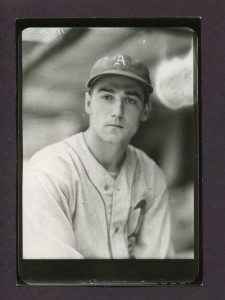
He was an All American pitcher at Duke for Uncle Jack. He signed with the Philadelphia Athletics, Connie Mack’s team, after graduating in 1933. At age 25, on June 8,1933, he made his major league debut, entering a game against the Yankees in Philadelphia. The first batter he faced was Babe Ruth. The Babe took him deep, hitting one of the longest home runs of his illustrious career. Bobby would tell the story of that home run for his Williams boys over and over. It took him about a half hour to tell it, embellishing every detail, smiling all the while. He would leave out the fact that he retired Lou Gehrig and Tony Lazzeri to end the inning. He got his first Major League save that day

“Led the league in hittin’ in ’33,” Bobby would “brag.” “Went 2 for 5,” he would add with a wink (all true by the way).

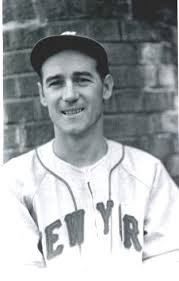
After 21 appearances in 1933, Bobby told “Mr. Mack” that his arm was a little tired. He was immediately sent to the minors where he stayed for nearly ten years, playing in Syracuse, Birmingham, St. Paul, Shreveport and Jersey City, minor league cities for Boston, the Chicago White Sox, the Chicago Cubs and the New York Giants. He was called up to the Majors for another 9 appearance stint in 1943 with the Giants and then was released in June, 1943 at age 35. He joined the Navy where he spent two years and then came to Williams in 1946 to coach until his retirement in 1973.

During the spring of 1970, after the Kent State shootings, the occupation by students of the administration building at Williams and the early dismissal of the student body, Bobby faced a team of mostly liberal, determined and genuinely concerned players who told him they were not going to finish the season and were going home.

“Why would you do that?” Bobby asked. “We have games left. Why do you want to go home? I know you are upset, but this is baseball. Please don’t mix baseball and politics. Please take a couple of hours and come back and we’ll talk again.”

No one could really answer Bobby’s question and after an hour of gentle discussion, the team returned to Bobby’s office to tell him they would stay and finish the season. He was right and so were the players. And it turned out ok.

For those who knew, played for and loved Bobby Coombs, his greatest talent was being a beautiful human being; loving life, laughing, joking with his players, puffing on his pipe, enjoying the sea, recounting his appearance against the Babe.

Bobby has been gone since 1991. But, every spring, when the snow melts, players gather to get ready for the season and the grass gets green on Bobby Coombs field in Williamstown, Bobby comes to mind. He was a special man.
 
 
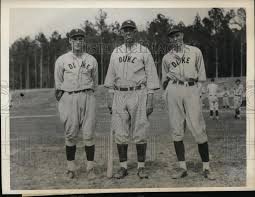
Bobby (left) at Duke in 1932 with Coach (and Uncle), Jack Coombs (center) and teammate Charles Herzog Jr.


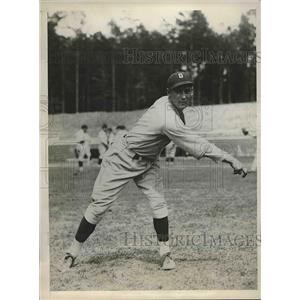
Bobby at Duke in 1933, his senior year:


Bobby with the Philadelphia Athletics in 1933, his first season in the Major Leagues:
 
 
Bobby with the New York Giants in 1943, his last in the Majors: