
 |
Joe Fitzgerald
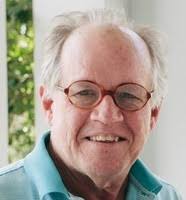 |
The following obituary appeared in the Litchfield County Times:
Joseph Michael Fitzgerald III passed away unexpectedly on the golf course of Lake Waramaug Country Club in Washington, CT, on July 10. Joe was known for his business acumen and genuine warmth and generosity, and he spent his final years doing what he loved most: playing golf with his wife, Betsy, going to concerts, watercolor painting, playing the guitar, piano and harmonica, buying gifts, and spoiling his grandchildren. He leaves a rich legacy.
Joe was born in Montclair, NJ, on July 22, 1949, just four minutes before his identical twin, Paul. He is also survived by his younger siblings, Nancy, Tim and Mark. Their childhood in Glen Ridge, NJ, was full of laughter and backyard games, and they stayed in close contact throughout their lives.
Joe attended Holy Name School in East Orange, NJ, and organized their 50th reunion in 2012. He then attended The Lawrenceville (NJ) School, where he starred in football, basketball, and baseball (batting a school-record .513 his senior year). His devotion to Lawrenceville was central to his life; over the years he served on the Board of Trustees and was class agent, class secretary and reunion chair, most recently for the Class of ’67 50th reunion. His two children, three nieces, and one nephew followed him there.
Joe attended Williams College, where he played football and baseball, receiving his BA in 1971. He stayed connected to Williams and his classmates throughout his life. Later, Joe had the joy of driving up to Williamstown with Betsy on many fall Saturdays to watch his son play on the same fields.
After college, Joe taught history and English and coached at the Canterbury School in New Milford, CT, where he met Betsy, to whom he was married for 42 years. He received an MBA from the NYU Stern School of Business and enjoyed a successful career in Investor Relations at Capital Cities/ABC and Seagram Universal in New York City and at MGM Studios in Los Angeles. These positions allowed him to travel the world and meet many of his heroes in music, film, and sports.
Joe truly loved Lake Waramaug Country Club, where he was a member for 34 years. He devoted many years of service as a member of the golf and house committees, as treasurer of the board, and ultimately as president from 2013-2015. He was instrumental in spearheading the installation of the course irrigation system and in envisioning the new clubhouse project completed in 2018.
In addition to Betsy, Joe is survived by their two children, Tucker of Moscow, Russia, and Sophie Burke of Dedham, MA; their spouses Kseniya Simon and Sam Burke; and two grandchildren, Leon Simon and Owen Burke. He is also survived by 25 brothers and sisters-in-law as well as 14 cousins and 32 nieces and nephews. Joe especially enjoyed career counseling with his extended family, spreading his joy of music and art, rooting for his beloved Yankees and Giants, maintaining lifelong friendships, and making new ones.
A celebration of life was held on Saturday, September 14 at 11 a.m. at the Chapel at The Lawrenceville School, 2500 Main Street, Lawrenceville, NJ.
Getting to Williamstown
Getting into Williams wasn’t easy, but getting there could be even trickier. Please share some of your more memorable travel tales, changing names to protect the innocent or guilty as needed.
Dean Hyde has described traveling to Williamstown by train as an undergraduate.
College in One Day — Wellesley
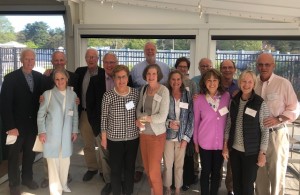
Members of the Classes of 1970 and 1971 got together for this event in Wellesley, MA, on May 11, 2019. Steve Brown reports:
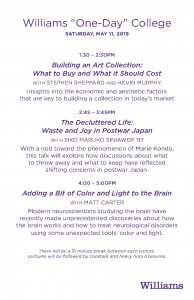
“We had wonderful time at a College in One Day program on Saturday afternoon, May 11. The program featured 3 one-hour presentations by 4 fabulous Williams professors covering a course on purchasing art for the Williams College Museum of Art, the decluttered life in postwar Japan, studying brain activity by using using light to stimulate specific cells.
After the event, we adjourned to the Eyres’ house in nearby Wayland for dessert and coffee with wine and dessert supplied by Kent Rude, Dave Olson and Bob. We have a lot of generous and talented classmates!!”
Mike Foley, Dave Newton and Ilene Cooke, Steve MacAusland, Bob and Katie (’73) Eyre, Dave and Susan Olsen, Laura Foley, Ginny and Kent Rude, Sue and Steve Brown, and Camille and Doug Bryant. |
|
|||
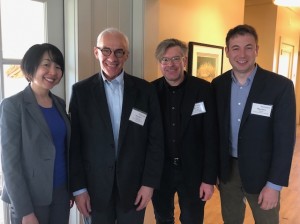
Williams faculty: Eiko Maruko Siniswer ‘97, (History); Stephen Sheppard, Class of 2012 Professor of Economics; Kevin Murphy, Senior Curator of American Art, Williams College Museum of Art; and Matt Carter, (Biology). |
Brandywine Museum, May 3, 2019
Steve Brown sends the following report on a Pennsylvania get-together in the spring of 2019:
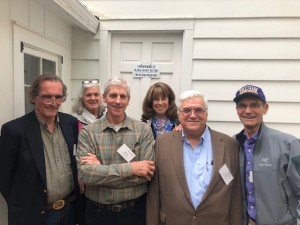
Here is a picture from our May 3 Brandywine museum get together outside of Andrew and Jamie Wyeth’s studios. From left to right, Bill Hutchison, June and Rob Farnham, Sue Brown, Nick Tortorello and me. (We should have put the real painters, June and Sue in front!!)
What a wonderful afternoon viewing three generations of Wyeth family paintings.
 |
Rob Farnham’s Texas Trip
Rob visited several classmates on a trip to the Texas April 8th to 11th, 2019. Here’s his report:
Texas is a big state, Houston is a big city, Corpus Christi embarks on a towering bridge, Austin engulfs with ease the old airport location and the Hill Country is rolling. How engaging when a classmate says he will meet me at the Breakfast Klub for a little “Houston funk” while the night before I sampled some of the local craft beer: Shiner Bock, St. Arnold’s Amber and Summer Pilsner at Goose Acres. Arriving at the appointed location prior to its opening, I was met by the entire staff as the doors opened and a round of clapping, smiles and energizing highlighted their stated mission of just serving “good food”. Indeed, my breakfast with Jim Noel, a Houston native, confirmed the food.
Early exposure to the concept of attending Williams is very varied throughout our classmates, certainly from the Texas environs 50 years ago, but somehow the grandmother of a family friend told him Williams was his place. Jim became a corporate banker right after graduation and returned to his Houston roots whereupon the family business in the early 80’s desired his attention.
The oil field, tubular goods industry in Texas is not for the feint of heart. Steep declines in the economic fortunes of the oil patch and rocking upturns leave a man’s financial nerve often under siege. Jim’s business fuses various pipe joints to particular grades of steel piping to withstand the forces inherent in the increased technology, depths and pressures associated with modern drilling programs. His degree from the College could not prepare one for this business craft.
He speaks of Professor Park, of the Physics Department, largely in relation to a Winter Study course he took. Quantum physics explained to the layman, he states. Jim served on the original Winter Study Committee and this left an appreciative mark for a chance to pursue subject matter outside of his economics major. He also mentions Professor Waite, remembering his German history course along with Waite’s “iconic and strong” presence on campus.
Additionally, Jim acknowledges friends Bill Gardner, Jim Ackerly and Chip Herndon, who was with us for only two years, but remains a friend he sees on visits to Tennessee. Bring them all back, we would welcome the reunions.
| No stranger to the vagaries of the business cycle, John Untereker, embodies many of the adaptive characteristics of the liberal arts experience demonstrated by his itinerate march across the employment landscape. Landing on one’s professional feet after merger cuts, desired relocations for greater family fabric or just opportunity, John is well travelled.
Arthur Anderson and auditing assignments brought John to Houston and NL Industries shortly after graduation and exposure to the drilling fluids business as a CFO (Chief Financial Officer). |
|
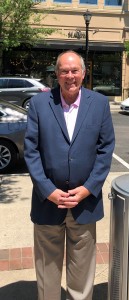
A move to Louisiana for ten years of life and toil with Petroleum Helicopters Inc. (PHI) introduced him and his wife, Mary, to the culture of this state, which presents a tight knitted, social environment not impossible to enter, but difficult, nonetheless. Back to Houston after adopting a son (now age 31 and an architect) and the desire to be nearer family, John became the CFO for a cardio related company that ultimately merged with the public company powerhouse, Merck. He was out and forced to join a power distribution company needing financial management and public company knowledge, which John possessed. Lastly, a stint at a smaller, private company owned by a Brooklyn Jew interested more in his family, moral fiber and general wisdom versus a specific skill set. Varied, indeed, and a tribute to a foundation from the Purple Valley.
I am always delighted to learn of the “under the radar” exposures classmates experience while at Williams leaving a lasting influence on their life. A chance class with Professor of Music, Shainman, established an interest in opera and now John and wife are regular patrons of the Houston Opera and enjoying it immensely. Reading is more prominent upon retirement and he mentions finishing Tolstoy’s War and Peace, recently along with Nathanial Philbrick’s writings. As we mused about the Williams experience, John remarks about the steep learning curve back then “and the process slows as we age”, a prospect less flattering than one would wish.
From Houston, I ventured south to Corpus Christi and a city along the coastline engaged in the petro-chemical refining industry and its new Harbor Bridge project that marks the entrance from the North to the City. The completion will mark the tallest point in South Texas and the longest cable stay bridge in the country. The bridge towers will stand 538 feet tall and will accommodate global shipping vessels greater passage to the channel where much of the industry is located.
| I motored over the old bridge to meet Lon Hill, whose family has long established roots in the City and in the Rio Grande Valley, a place he occasionally returns to. Lon’s grandfather developed land in the Valley. Early on, Lon was versed in Williams’ lore as his father and uncle both attended the College and he remembers his father celebrating his 50th in 1993.
Lon is a self-described introvert who “studied too hard at the exclusion of other experiences” while on campus. He carries a regretful thought surrounding the idea he “wished he was more well rounded while there” in pursuits and interests. |
|
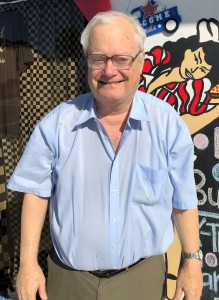
Binks Little, of the Religion Department is remembered as Lon was a major in that department and subsequently received an MA at Union Theological Seminary at Columbia University, but never finished the PhD program. His professional wanderings before returning to Corpus Christi in the early 1990’s to become the caregiver for his mother and father leaves him believing he would have benefited from an education that was more skill specific upon graduation than a liberal arts curriculum provided.
But, Lon retains a heartfelt opinion that Williams is a “precious place”. He recalls Sey Zimmerman, a roommate and fellow Texan, and his wife, Janet, who lived in Corpus Christi where the two married, an occasion Lon recalls attending at the time. In attempting to convince Lon to return to our 50th, he invoked the story of taking his father in 1993 to the Albany airport after escorting him to his 50th when he suffered a serious stroke on the flight home. “I will try to put that aside. In some ways it underscores how fragile and precious are opportunities to get together with classmates.”
| After meeting Lon, I drove back to Houston for a dinner with John Clemmons, a long time resident of the City and an MD with a specialty in gastroenterology. John’s wife was from Houston and after a residency at Emory University he began his medical practice there, which continues to this day. In a wide-ranging discussion of his path through life from an all Black high school in Savannah, Georgia, John relates a story to my question as to why he remains practicing at this age. “I grew up with parents that believed serving was important”. |
|
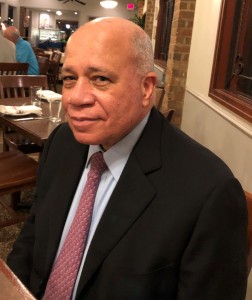
Both parents were teachers, but his Dad’s road to success necessitated surmounting professional hurdles a Black man encountered in Georgian society at that time. Desiring to attend medical school, his father was denied entrance, which John believes was the product of racial bias. Undaunted his Dad pursued and became a very successful physics teacher and never looked back. This home-centered culture of serving benignly interrupted our dinner. “I am old school, “ John stated, after he briefly addressed a telephone call regarding a patient “and I still take after hours calls.”
Although he expresses our time at Williams as one of “historical transition” concerning the development of cultural and academic programs for Blacks on campus and recognizes today’s changed atmosphere, his experience while there challenges my knowledge of the searing and emotional viewpoint of the Black, campus population. He recalls the eloquence of Preston Washington ’70, one of the leaders of the Black occupation of Hopkins Hall, and his ability to examine the slow pace of change at the institution according to a Black mindset. I mentioned I was not privy to the internal discussions of this small group nor did I ask he detail them. Although I understood at the time what was largely going down, I admitted that I do not feel my insight into the nucleus of thought within this group was whole or of depth. John was a member of the group that sat in during the occupation along with Forrest Jones.
Coming from an all Black high school, he admits adjusting to a small, mostly white student body, as well as, the academic challenges, which I confessed was part of my experience, kept him focused and somewhat removed from engaging other classmates outside of his immediate roommates. His natural reserve and desire to serve found an outlet in the ABC programs (A Better Chance) on and off campus. His summers were spent on the Williams campus for two years and the Carleton campus in Minnesota for one, tending to duties tied to ABC. During Junior and Senior year he lived off campus at the Huxley House mentoring high school students attending Mt. Greylock’s own ABC program. He made recruiting trips with Phil Smith, Admissions Director, to better serve Black students in their choices regarding further education.
John’s reminiscence of his self-styled engagement with the College was unfettered by any fawning description of his time there, but he left me with his recognition the Williams education throughout his life and career path gave him “standing” within his social and professional communities.
| Rick Ertel drove down from the Hill Country to meet me in Austin at a location formerly part of the old airport. Now developed, the mixed-use structures create a pleasing architectural reuse of the land mass. A lawyer by profession with a Harvard Business degree to fortify his skill set, he practiced law with Aiken Gump out of Dallas. Now retired to the Hill Country about an hour outside of Austin where his wife, Stephanie, has a family history, Rick is engaged with state & local, social and political efforts through Texas Impact (TI). TI was founded in 1973 as a non-profit entity comprised of Christian denominations, regional Jewish and Muslim social justice committees and local interfaith councils.
|
|
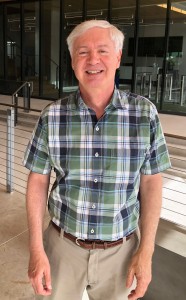
He mentions a recent initiative by TI to coordinate ecumenical donations to state relief efforts subsequent to hurricane Harvey. This information was critical in allowing the state to request federal funds based on amounts contributed statewide (TI $200 MM and TX $500MM). Rick serves on the Board and is currently in a leadership position at TI, while Stephanie is active with pro-bono efforts at the state legislative level there in Austin.
Mathematics were a staple for him at Williams and he recalls Professors Hill and Grabois, but makes a special mention of Faison and Stoddard of the Art Department. His children over the years were always surprised by the juxtaposition of his professional background and his educational exposure to art while at the College. He roomed with Hugh Hawkins and upon requesting he call classmates re; our 50th, he stated “all of his close friends return for the reunions.” Make it so I think to myself.
As we discuss the Williams experience, I am reminded once again of the theme to his thoughts, which coalesce around the realization that “the most important element to a Williams education is the extracurricular activities bringing broad exposure and the dialogue with classmates providing knowledge and inter-personal skills”.
Rob Farnham’s West Coast Trip
Rob visited several classmates on a trip to the West Coast April 16th to 21st, 2018. Here’s his report:
Andy Fleming: You are traveling abroad and hear through a neighbor’s loose communication that the Santa Rosa fires are close and then receive a further message that your house is now an ash heap. This is miscommunication in the Internet world, he thought. He and his wife went into denial. But, his house did burn down (the Tubbs fire alone took down 2800 homes and burned 34,000 acres) and they returned to wrestle with insurance and living with their children for 30 days before relocating to an apartment in downtown Santa Rosa. They intend to rebuild on the same site.
Upon graduation, Andy applied in North Adams for a conscientious objector designation after receiving a dreaded number, #154. When the draft board later stated no number over #150 would be so drafted he moved to Chicago and drifted until an assignment to the National Health Board in San Francisco was offered. Studying various disease-related issues in the hot bed of a drug culture at the time, Andy later decided to attend a program teaching machinist skills. He does not philosophize as to the why, except the challenge and satisfaction of working with one’s hands and mind simultaneously clearly spoke to him at the time. He parlayed that education into the high precision machine shop at Hewlett Packard. Precision measurements of the parts for computer manufacture led him to work developing the calibration devices necessary to measure the micron tolerances so associated.
What the Williams education gave was clarity of expression and the ability to write in simple, declarative sentences what the engineers were producing while explaining the technical foundation the work was based on. Most could not do this.
Gary Barth: “ I wrote my senior paper for the Williams in India program on Emptiness.
Years later in a private meeting with the Dalai Lama, I asked him, ‘if I can’t find a Tibetan teacher who speaks English, what do you think about studying with one of the California based Zen Masters?’ His prescient answer, given with a chuckle: ‘I think the Tibetan emptiness is bigger.’
Truly amazing answer: truthful and a Zen koan back to me: how could something without dimension have inferior dimension?”
Gary has continued over the years as a participant in programs abroad to reduce blindness through pro-bono cataract surgery and corneal transplant operations. His eye surgery practice in Santa Rosa includes 7 surgeons and he serves on the Board of the Seva Foundation for the prevention of blindness.
He reminisces about his Long Island high school where he played lacrosse for Renzi Lamb, the now retired coach of Williams lacrosse. He states when he found out Williams was looking for a new coach he called Renzi about the opening.
Like so many classmates, he found intellectual stimulation in those “under the radar” discussions or meetings, the importance often not recognized till later in life. He found a pocket of individuals through the Religion Department (Prof. Eusden) that would gather to discuss moral issues or subject matter pertinent to the day. Some students and some faculty members from other disciplines. He views these moments as quintessential Williams and impactful later in life. The sharing of ideas with mental space enough for various world views and questions one needs to unravel on his own.
Wynne Carvill: Currently serves on the Alameda County Superior Court in CA a position held since 2003. He, too, participated in the Williams in India program and remembers Scott Miller, Bill Loomis, Dale Riehl ’72 and Steve Kendrick ’72.
What was seminal in his development was the manner Prof. Gaudino conducted his classes. Gaudino did not judge nor indicate his own conclusions, but attempted to penetrate other’s viewpoints and the respective influences on the thought process. What was the foundation of the thinking: family, culture, geography or experiential factors? Out of this exposure developed a blend of listening to one another and attempting to give credence to viewpoints distinctly different than one’s own.
For two years now he will head the Administration of the ACSC dealing with human resources, budgets, etc. “Someone has to do it”, was the refrain of his professional brethren. And, “Don’t get into arguments with the LA County system regarding budgets, because they always win.”
He notes distinctions in character in what comes before the courts from different municipalities, even those with contiguous borders. With understanding, he expresses the complex interface of economic, cultural and police management issues that give rise to the court proceedings.
Bruce Irvine: For a man who later in life suffered significant heart issues and is now under chemotherapy for lung cancer, Bruce has a quiet strength without victimhood entering his philosophic outlook. Directly after graduation he returned to CA (a Los Angeles high school experience) and tended bar. He then managed a racket ball facility for five years before joining a California bank within its retail division. The retail experience led him to a position in the commercial banking network of the same bank where he served as a relationship manager for 20+ years.
He remembers his Williams experience with a thought without chronicling the detail: “I believe I was too young to enter Williams at age 17.” Prodded slightly for further insight, he considered momentarily before stating, “My high school was pretty restrictive. Too much freedom at Williams.”
He asked about Mike Caruso and said Mike was his roommate. He would very much like to see him again.
Jane Gardner: One of the 7 females graduating with our Class. She spent two years at the College and was part of the “Gaudino” nexus with Wynne Carvill, Bill Loomis and Metzger. She remembers Clay Hunt and Samuels of the English Department fondly and received a Watson Fellowship, which she utilized to study Dante in Italy with the same mentor Clay Hunt studied with during his formative years. This was a one-year course of study, but she found this a “lonely experience”.
A career in advertising recently morphed into a partnership using a skill set honed in her previous profession, but unrelated. One project this partnership structured along with other foundations is the “Big Lift”, a reading program in San Mateo County in CA for children in the third grade and lower. A holistic approach with interfaces with family, etc. to imbue the children with an interest and desire to read and learn. Third grade and lower is the key according to research and studies she was instrumental in.
Not sure her insights into the experience of being female at the College are meaningful, she notes, “the experience was the experience”. Although in another discussion she mentioned the visceral experience of the “ferment of the late sixties”.
Frank Murray: One of 11 children from Dallas. The mother of a friend who attended Harvard suggested he look at Williams. He ordered course catalogs from Williams, Amherst, Princeton and Notre Dame (his Mom’s choice). “ND was too big”, so he read all the catalogs and could tell, “Williams was the place for me with its emphasis on teaching”.
Frank has spent 30+ years teaching at St. Mary’s College in Maraga, CA, a Christian Brothers affiliated enterprise (the French derivative). The curriculum utilizes the Great Books as mandatory for of all students for a portion of their education. The history of this arm of the Christian Brothers included the education of the poor and 1/3 of St. Mary’s student body is Pell eligible and ½ is comprised of ethnic minorities.
Frank returned to Dallas after graduation and applied to the Dallas Draft Board for conscientious objector status. Four Board members were WW II veterans with little sympathy for a CO. Rubber stamping, No, was an efficient way to work through the files. A family friend, a veteran himself, indicated he “despised” what Frank was doing, but would write a letter verifying Frank’s honesty and integrity. This was the only item the Board read in his file and concluded he should be given the CO status. The two-year commitment included an experience at a pre-trial holding facility within the prison system.
Frank was recruited to teach at his Dallas high school, which he did, until he decided he did not want to be another, “Mr. Chips”, so he completed a Masters degree in English Literature at Stanford.
An application to St. Mary’s was accepted and 30+ years of teaching crosses other disciplines besides English Lit. One is the theater. He mentions occasions when David Strathairn is in San Francisco performing of taking several theater students into town to meet Strathairn at the Café Mason just outside one of the performing arts venues there. Discussions regarding the art form from a practitioner are a lot like Mark Hopkins sitting on one end of the log.
John Barkan: John is another classmate with two professions under his belt including the earlier one spent in the advertising world. He then pursued his teaching credentials and recently finished a 20+ year career in education in San Francisco.
John is originally from San Francisco and met wife, Joan, at Skidmore. As a lifer in San Francisco he remains living in the first house purchased over 40 years ago and recently renovated portions of the structure, to which he states, “never again”.
Travelling and grand kids are now his focus.
Ned Palmer: Ned now lives on Bainbridge Island in WA, the home of the Bloedel Reserve (worth a visit for the gardens). His wife, Susan, spent two semesters from Mt. Holyoke at the College.
Ned tells of acquiring his pilot’s license at North Adams just before graduation and remembers Rick Beinecke also taking lessons there at the time. Like all rookies he had a harrowing story of a flight to Milwaukee through stormy weather. I wondered if such buffeting was valuable in his career in banking (NYC?).
Ned spends some time in Hawaii each winter and indicated he visited with Jim Tam there recently. He also returned to the College in 2012 to attend the Charlie Waigi ’72 Bicentennial Medal ceremony. Waigi is currently working in Kenya and Ned is involved with a group spearheaded by Waigi.
Camille Townsend: Camille is a Smith grad and attended the College for two semesters. Born and raised in PA she headed the development department for 30+ years for a private elementary school with 600 students.
Williams was an opportunity to change her environment and dislodge herself from whatever rut seems to haunt all of us on occasion during a College career. She was a geology and art history major so the curriculum at Williams was robust enough. Character traits allowing change to enter her life are now on display as she moved to Seattle three years ago to be near her daughter and granddaughter. With another potential move to Durango, CO in the near future the vagaries of life are settling around her with new equanimity.
Asked what the Williams exchange experience was like, she indicated there were few issues of real friction. The occasional bathroom facility mix-up, the lack of swimming time for women in the pool (men swim nude, “supposedly”), but negative friction from gender bias was largely absent from her experience. She thought the Administration (Nancy McIntire) did an admirable job in transitioning for female students.
In answer to, what motivates you now?, she states, “I have not figured that out yet. Possibly some volunteer work within the art world. A gallery or other.”
Jim Stearns: A law degree from Georgetown University had a curious and somewhat Byzantine relationship to Jim’s pathway. After moving to Rochester and a job reviewing contracts for software, he was counseled to learn more about the technology he was reviewing. This is understandable given items such as vocabulary, technical nuance and product differentiation. So he took math courses and computer science (old Fortran) and “got hooked”.
At this time in his career owning a computer store appeared to offer entrance into the future and with a partner he opened one. “This was a good idea, but ten other individuals in the same location had the same idea and the business did not work out”.
Joining Hewlett Packard, however, where he served for over 20 years in several divisions did. When he was assigned to a division of HP in Columbus, Ohio he finished a Masters in computer science at Ohio State. He also served HP in Colorado Springs and Fort Collins, CO.
Now with the National Oceanic and Atmospheric Administration (NOAA) in Seattle, Jim is working on a project to move the data gathering for commercial fisheries from paper to the digital age. Counts within any catch including volumes, sizes and species and are cumbersomely created. Ask Jim about the software and technology.
David Albert: A discussion with David leads to many roads on a path less travelled, but few statements can spark an intrigue more than, “Good things happened to me when I had no money”. From a blue-collar family and a Queens, NY location, he attended a magnet school in Manhattan. The family was gifted musically and Professor Shainman influenced his choice of Williams.
His time at Williams included some friction with classmates whose families were considered wealthy, but his exposure to their parents became an influence for future pursuits. Conversations with those parents included acts of philanthropy with non-profit organizations and travel to foreign countries. These became a touchstone.
He notes one of those “under the radar moments” when listening to the Williams Radio program one night where they played a musical piece using a veena. He did not know the instrument, but researched it (Indian), found it of some fascination and now acknowledges it as the germination of his interest in the country.
During his two-year study at Oxford under a Carol Wilson Fellowship, he bemoaned the lack of funds to travel extensively to other near and distant countries. He did, however, find an overland route to travel to Tehran, Iran to meet up with an Iranian student class of ’73 that David believes was a “trial” for Shah Pahlavi’s son to attend the College. He followed Oxford with a degree from the Committee on Social Thought, University of Chicago.
He concluded these academic peregrinations by being a founding member of New Society Publishers, a non-profit publisher of books as tools to help build a new society. His writings on home schooling, which he and partner, Ellen, accomplished with their two children, are considered definitive works on the subject and published by the enterprise. I left his house with five to read.
In 2006 David was discussing water projects in under-developed countries with a friend and in 2009 they raised the funding to start a non-profit organization, Friendly Water of the World, which utilizes bio-sand filters, a low-cost technology. He is the current chairman. When asked what country they should initiate a program he said, “Burundi because it’s the second poorest country in the world”.
Trick or Treat
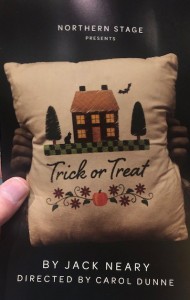 |
Steve Brown provides notes about a performance of Trick or Treat starring Gordon Clapp in New York on February 16, 2019:
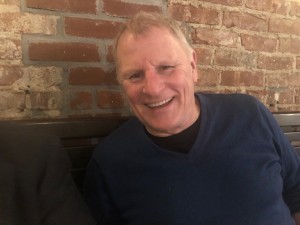
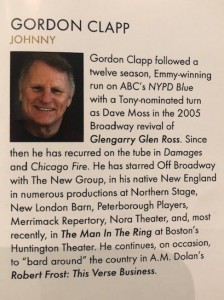
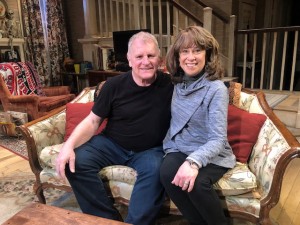
Sue and I met Gordie and Gene Bauer for lunch before a Saturday matinee performance of Trick or Treat in NYC. Gene was in the midst of a 4-day, “performing arts” blitz in which he was seeing numerous plays and a New York Philharmonic performance while his wife attended an art education conference in NYC. In Trick or Treat, Gordie plays the lead role of a father of a dysfunctional family whose actions lead to a Halloween night filled with twists and turns. Gordie does a great job in a role filled with emotion. Gene, Sue and I were all amazed how Gordie could transform from the nice, funny and warm person he was at lunch at 1PM into this tormented father who must deal with a family with lots of serious past and present issues only an hour later. Bravo! Rob Farnham and Dave and Audrey Kubie are scheduled to see the play on the 17th. Included are pictures from lunch, and Sue and Gordie on the set after the play.
Rob Farnham adds:
Dave and Audrey Kubie, my wife, June, and I by unanimous proclamation considered the performance well-acted. Gordie developed his character with savvy and infused it with the right touch of emotion and hubris. The play developed an edginess as the actions of the character he played left one having to judge whether they were heroic or just pathetic. Great to see Gordie ply his craft with deftness.
|
|
|
|||||
|
Winter Study 2019
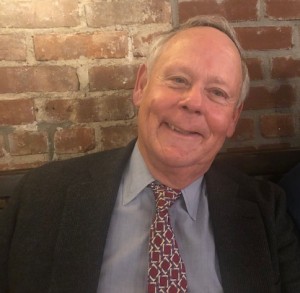
Lots of ‘71 help with Dave Olson and Steve Brown’s Winter Study course on Mock Trials. “Judge” Rodney Brown traveled from Rye NY to preside over the first trial the course. Doug Pickard and Colin Brown (who traveled all the way from warm Florida) served as unbiased and interested jurors for the first trial. Bob Schwed took a day off from teaching on his own Winter Study course on deal-making to serve as judge for the second trial and Sue Brown ably served as a juror.
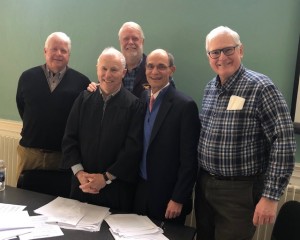 |
The trials were preceded by dinner at the Browns the evening before:
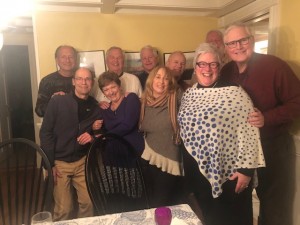 Paul Willis, Steve Latham, Colin Brown, Rod Brown, Dave Olson, Doug Pickard. |
|
BY Irvine
 |
Bruce Yoder Irvine, also known as BY, was born in 1950 in Los Angeles to Louise Irvine (nee Yoder) and Dr. Alexander Ray Irvine Jr. He passed away on January 26 after a two-year battle with cancer. Bruce went to high school at the Harvard School for Boys in North Hollywood and then attended Williams College in Williamstown, Massachusetts. Shortly after graduating college he moved to the San Francisco Bay Area where he lived until his death.
His love of cooking was fostered in his childhood home and blossomed after college as he worked in the restaurant industry in various capacities. It was while working at The Dutch Goose in Menlo Park that he met his wife of 40 years, Merrylen Sacks. His second career was as a Retail and Commercial Banker in the Bay Area. When not working, Bruce had many interests including golf and fishing. He had a deep appreciation of art and loved being in nature. Karate was one his true passions and he trained for many years culminating in a 4th degree black belt. He was an athlete and avid sports fan, attending countless Stanford football and basketball games. He was also a decades long Warriors fan, well before their present-day glory.
Nothing gave Bruce more pleasure than being surrounded by his family and friends, especially while he barbequed or prepared a meal. He was an intelligent and witty man, who always conducted himself with equanimity and grace until his final days. He was an engaged father, grandfather and friend. The gifts of love, support, kindness, and generosity that Bruce gave to so many over the years were acknowledged by the heartfelt messages he received in the last weeks and months of his life.
Bruce is survived by his wife Merrylen, son Jesse (Jana), daughter Sarah (Boris), grandchildren Adam, Aliyah, Ezra and Eli, his brothers Dr. John Irvine and Stuart Irvine and their families, as well as many beloved nieces, nephews, cousins and close friends. He was preceded in death by his parents and his sister, Rae Anne Casazza.
His funeral will be held at Congregation Beth Am in Los Altos Hills at 10:30am on Wednesday, January 30, followed by burial at Hills of Eternity in Colma with luncheon to follow. Shiva Minyan will be held at his home Wednesday and Thursday evenings at 7pm. In lieu of flowers, please consider donating to Congregation Beth Am, Mission Hospice, The Bonnie Addario Lung Cancer Center or The Pacific Stroke Association.
San Jose Mercury News/San Mateo County Times on Jan. 29, 2019