Fall 2025 Mini-Reunion

Our Fall 2025 Reunion will be held September 19 – 21.

Details from the College are available here.

Information about housing is available here under the “Stay” menu item at the top of the page.

On August 1, Steve Brown sent this email to the Class:

Dear Classmates and Friends/Family of the Wonderful Williams Class of ’71,

   We write with 2 big, Save the Dates for our Class in Williamstown in next 12 months. 

    1. MINI-REUNION — Sept. 19-21.   Reunion with other post 50th classes and Sat. night dinner for ’71 only at Taconic( which will feature special post-dinner concert by 2 current Williams students singing Beatles, etc!!!).

          Friday — golf, visits to the Clark or MassMOCA, afternoon presentations by faculty, evening get together with  other classes for cocktails and buffet dinner at Williams Inn. Saturday—additional faculty presentations, update by Maud, tailgate, football against Colby, private dinner just for ’71 at Taconic.  You should have received your registration materials by now – if not, please let us know.

      2. Our 55th REUNION  — June 11-14, 2026– Yes, it is here already!! We are  back on schedule on a full reunion weekend so lots going on!!  We  plan on having our own reunion headquarters for hanging out, Friday and Sat. dinners, and Sunday brunch. Plus  reserved pickleball time.  We hope to see everyone back, including those who wanted to come back to the 50th but had scheduling conflicts. Much more to come, but wanted to make sure you saved the dates. 

Also, VERY IMPORTANT note about housing– if you have any inkling you may want to attend our 55th, MAKE YOUR RESERVATIONS NOW AT HOTEL/MOTEL, etc. You should check out cancellation policies. Over 1000 people will descend on Williamstown for reunion weekend. BTW — no rooms available at Williams Inn that weekend because all reserved for 50th class. For a list of hotels, motels, etc., check  out destinationwilliamstown.org   

      We look forward to seeing you there for one or , even better,  both events! Any questions or suggestions, just let us know.

       Go Ephs!!

            Steve and Mike

        [email protected]  or mobile 610-291-1288

       [email protected]    or mobile 716-713-0623

“Stayin’ Alive” at 75 (and Beyond)

Steve Brown writes:

Dear Classmates and Friends/Family of the Outstanding Class of ’71,

Our Class Zooms are back!! We are planning 3 or 4 zooms leading up to our 55th reunion which is only 16 months away  on June 11-14, 2026. 

The first Zoom is “Stayin’ Alive”  at 75 (and Beyond) featuring health tips from 3 of our many distinguished doctor-clasmates:

1.      Jeff Stein – who will discuss important steps to thrive at 75 and beyond so you can keep living as well as “When I’m 64”

2.      Bob Eyre – who will speak about cognitive diseases and what we can do to minimize risks so we “Don’t Stop Thinking About Tomorrow”

3.      Mike Rade – who will talk about diet and exercise so we can keep “Blowin’ in the Wind”  

We will also have plenty of time for questions and discussion.

Date and time: Monday, March 3 at 5:30pm (EST)

Link:  Join Zoom Meeting

https://us02web.zoom.us/j/87393425467

Zoom with Ian Fierstein from Jerusalem

     Ian has generously agreed to zoom with us on Tuesday, October 8 at 12:30pm (EDT), Here is the link:

             Join Zoom Meeting

             https://us02web.zoom.us/j/83945781595

             Meeting ID: 839 4578 1595

Steve Brown writes:

We all have lots of information available to us from news outlets on military strikes and political maneuverings, but Ian can describe the continuing impact the conflicts with Hamas, Hezbollah, and now Iran are having on the daily life of Israel’s citizens. Everyone who participated in Ian’s zoom last spring found it illuminating and moving. I am sure that that thoughts and prayers of all of us are with Ian and his family during this awful time of turmoil.

Fall 2024 Mini-Reunion

Our 2024 Mini-Reunion will be held in Williamstown October 18 – 20.

Friday, October 18:

  • Cocktails and heavy hors d’0euvres with other Post-50th Classes, 5:00 – 7:30, Faculty House.

Saturday, October 19:

  • Remarks by President Maud Mandel in the morning.
  • Tailgate and football game against Bates in the afternoon.
  • Dinner with ’71 classmates and friends at The Log, 5:30 – 7:30 PM.

Complete information is available here.

Class Book

  Our Class Book is available online at https://securedigital.menoreunionbooks.com/viewbooks/Williams71/mobile/index.html; the password is Williams_C71.


You can also view the book as a pdf.


For ease of viewing, we recommend:

  • When clicking on the link, if you see a “permission required” message, just ignore it; you already have permission! Enter the password and go.
  • Open to full screen. You can use the “four corners” icon in the lower right to do this.
  • Use the magnifying icon at lower left to enlarge the images suitably for 70-something eyes. If you have a large screen monitor, you may not need to enlarge.
    • A bar with + and – signs will appear at the top — you may have to hover over it to make it easier to see. You can use these to resize in smaller steps if you want to.
  • To flip pages, just click to the right or left background, or on the arrows. To find a specific page (see Contents, p.6) type the page number in the box at bottom center, then hit enter or return.
  • To find a particular person, type his or her name in the search box in the upper right, and then select from the search results on the left.
  • Questions? Write to John Ackroff or John Chambers.

Savor the Book a bit at a time, starting with particular friends or essays – there are many Classmates here, and we are many years down life’s road. Take Brandi Carlile’s advice:

“All of these lines across my face
Tell you the stories of who I am
So many stories of where I’ve been
And how I got to where I am
But these stories don’t mean anything
If you’ve got no one to tell them to…”

Those stories are here.  Who better to tell them to than our ’71 Classmates? 

We still hope the publisher will deliver print copies to home mailboxes before the August 7-10 Reunion, but at the rate we are going…that could be the 55th Reunion!


Winter Study 2020

Six of our classmates taught Winter Study courses in 2020 — probably more than any other class!  Subjects include Ethical Issues in Surgical Care (Bob Eyre);  Neuroscience of Learning (Judy Allerhand Willis, supported by her husband Paul Willis); Entrepreneurship, Negotiation, and Investment (Bob Schwed); and Mock Trial (Dave Olson and Steve Brown).


Bob Eyre, Steve, Judy, Bob Schwed, Paul, and Dave.

Some thoughts from our esteemed faculty:

Judy Allerhand Willis:

When I return here to teach winter study, I feel that excitement when awakening each morning to go to class (but this time refreshed from not having stayed up so late)!  The students are my teachers, challenging and enhancing my ideas with their insights and questions. I feel their optimism as well as their concerns. They appreciate the bubble of the purple valley and also recognize the privilege and responsibilities of the opportunity they have been given. They impress me by their goals to give back, care, be grateful, and continue questioning, exploring, and embracing their future challenges and opportunities.

   
    She’s done this before!
Bob Eyre:

I am thrilled to be in Williamstown for the month of January as an adjunct professor teaching a Winter Study course on Ethical Issues in Surgical Care. I conceived the course as a discussion of case studies that I put together to examine the many challenging situations that surgeons encounter from an ethical perspective. The main topics include surgical professionalism, the surgeon-patient relationship, conflicts of interest, substitute decision making, end-of-life issues, confidentiality, and ethics of access. For each of these, I prepared between 5 and 10 case studies that we dissect in detail in class. We will read and discuss Atul Gawande’s book, Being Mortal. I also structured this as an intensive writing course and each student will prepare four papers during the month reflecting on many of the ethical issues raised in the case studies. I edit these very carefully and meet with the students to discuss my comments and suggestions.

I have a phenomenal group of fourteen pre-med students in the class, quite evenly divided from first-years to seniors, with an equal number of men and women. I also have some students and Williamstown residents who are auditing the classes. The students have wide-ranging interests – many are on varsity teams, three play in the Berkshire Symphony, and all seem to be very intent on medical school after a 1-2 year break for research, clinical experiences, etc.

The range of topics explored in the papers has been impressive, including the influence of big pharma on physicians, concurrent and ghost surgeries, informed consent issues, the ethical obligation of hospitals to provide physician health programs to combat physician burnout, obligation to disclose genetic testing results, ethical conflicts in reporting abuse, and mandatory vaccination laws to name a few. Many of the papers have been truly exceptional.

It is really gratifying to see so many of our classmates sharing their time and expertise as adjunct Winter Study professors. It is a priceless gift that we are passing on to this generation of incredible Williams students.

 
Bob Schwed:

I have 30 students in my venture capital class, eleven of whom are on the men’s hockey team. I am uncertain as to whether that team concentration is a reflection of the entrepreneurial spirit of hockey players or a collective judgment as to the rigor of the course. Once I first proposed the course four years ago, I thought I would have many aspiring lawyers as I had taught a version of the course in law school as an adjunct professor. This year I do not have any students who have indicated that law school is in their future. To a person, the students want to start businesses, join early stage companies or be venture capital investors.

The highlight of the course, I believe, is the various guests that participate in class discussions and then meet with students to address whatever topics are of interest to the students or the guest. Two of our entrepreneur guests (and Williams alums) were Mark Wallace, the founder of Parlor Skis, which sells custom made skis, and Mary Imevbore, the winner of the Williams business plan competition in 2018, whose company sells wigs and hair extensions online primarily to Afro-American women. Mark also happens to be Dave Olson’s son-in-law.

 
Steve Brown:

David Olson and I had the pleasure of returning to Williamstown in January to teach mock trial. Our course consisted of eight 3-hour sessions divided up as follows: one lecture, five classes designed to help the students prepare for two trials; and the two final trials. We divided our 11 students up into two teams and each would present cases  for both the plaintiff and defendant switching sides in the same case in our final 2 sessions . This year’s exciting case focused on untimely demise of Mr. Gilbertson while trying to scale Mt. Everest. We were ably assisted by Judges Rodney Brown, whose 40 years trying cases made him ideally suited to the bench, and Bob Schwed, whose 40 years of making deals, made him an adventure on the bench for our fledgling lawyers. 

Our 11 students were all bright, engaged, from different backgrounds, and had different interests: first years to seniors, with homes from Massachusetts to Thailand, with majors stretching from math to poli sci, and some involved in athletics from rowers to softball players.  None of the students knew each other before the course, so it was very cool to see each group grow into a team bound by a common goal— winning the trials!! 
 
The most rewarding part for me was to see the students who were very uncomfortable on their feet in the first two classes get up at the final trials and make a seven or eight minute closing or opening argument or doing a direct or cross examination without hesitation and with a good, strong voice. Dave agreed that watching the individuals enhance such skills was rewarding, for we both believe that such skills never fall out of fashion. 
 
Another delight was getting together with other classmates who were also teaching Winter Study courses or in the area to cook, eat and socialize together.  Dave Olson and Steve Latham were our Head Chefs, supported by sous chefs Paul Willis and Judy Allerhand Willis (hot appetizers and dessert) , Bob Schwed cold appetizers), and Bob Eyre (salad). Bob Eyre, Rod Brown and Steve Latham played the role of our sommeliers. Sue and I supplied the kitchen and dining room table. A good time was had by all.  During the month, Bob Eyre also added a recital on the piano.
 
 Our Winter Study gang also enjoyed pizza at the Log with Jack Sands and Jorie and Steve Latham before watching the men’s basketball team beat Amherst in a 62-60 thriller. At the game, we were joined by Doug and Jane Pickard and Jay Healy ’68 in rooting the Ephs on.  Earlier in the season, Gene Bauer joined Steve, Bob Eyre and Doug for the win over Bowdoin, and Bob and Doug for the loss to Colby.

Gordon Clapp plays Hoover at the Lincoln Center

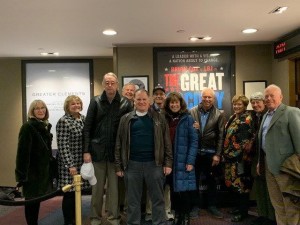
Gordon Clapp plays J. Edgar Hoover in The Great Society at the Lincoln Center through January 15th, 2020.

Steve Brown reports: “On Saturday, Nov. 16, a group of 18  ’71 Classmates and friends attended the play “The Great Society’ featuring our own Gordie Clapp as J. Edgar Hoover ( or “J” as referred to by LBJ in the play). Our group consisted of Jock and Anne MacKinnon, Steve and Jorie Latham, Shaye Hester, Rod Brown and Marcia Haydel, Bob and Denise Schwed, John and Louise Finnerty, Jack Sands, Dave and Audrey Kubie,  June and Rob Farnham,  and Sue and I.

 
We all enjoyed lunch at PJ Clarke’s before the play with Gordie and his wife, Elizabeth. It was great seeing Gordie in the play and remembering the years 1964-68. FYI — they did not feature any of Lady Bird Johnson’s visit to Williams College in October, 1967, which is described in our timeline.”


This picture was taken after the play in front of the box office: from left to right, Shaye Hester, Louise and John Finnerty, Steve Latham, Gordie Clapp (a/k/a J. Edgar), Steve and Sue Brown, Jorie Latham, and Jock and Anne MacKinnon.

College in One Day — Wellesley

Members of the Classes of 1970 and 1971 got together for this event in Wellesley, MA, on May 11, 2019.  Steve Brown reports:

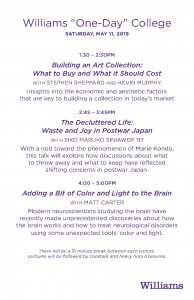
“We had wonderful time at a College in One Day program on Saturday afternoon, May 11. The program featured 3 one-hour presentations by 4 fabulous Williams professors covering a course on purchasing art for the Williams College Museum of Art, the decluttered life in postwar Japan,  studying brain activity by using using light to stimulate specific cells. 
 
After the event, we adjourned to the Eyres’ house in nearby Wayland for dessert and coffee with wine and dessert supplied by Kent Rude, Dave Olson and Bob. We have a lot of generous and talented classmates!!”


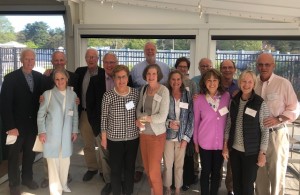
Mike Foley, Dave Newton and Ilene Cooke, Steve MacAusland, Bob and Katie (’73) Eyre, Dave and Susan Olsen, Laura Foley, Ginny and Kent Rude, Sue and Steve Brown, and Camille and Doug Bryant.


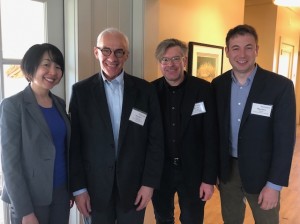
Williams faculty: Eiko Maruko Siniswer ‘97, (History); Stephen Sheppard, Class of 2012 Professor of Economics; Kevin Murphy, Senior Curator of American Art, Williams College Museum of Art; and Matt Carter, (Biology).

Brandywine Museum, May 3, 2019

Steve Brown sends the following report on a Pennsylvania get-together in the spring of 2019:
 
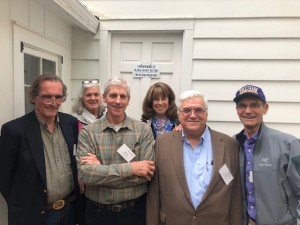
Here is a picture from our May 3 Brandywine museum get together outside of Andrew and Jamie Wyeth’s studios. From left to right, Bill Hutchison, June and Rob Farnham, Sue Brown, Nick Tortorello and me.  (We should have put the real painters, June and Sue in front!!)
 
What a wonderful afternoon viewing three generations of Wyeth family paintings.
 

Rob Farnham’s Texas Trip

Rob visited several classmates on a trip to the Texas April 8th to 11th, 2019. Here’s his report:

Texas is a big state, Houston is a big city, Corpus Christi embarks on a towering bridge, Austin engulfs with ease the old airport location and the Hill Country is rolling. How engaging when a classmate says he will meet me at the Breakfast Klub for a little “Houston funk” while the night before I sampled some of the local craft beer: Shiner Bock, St. Arnold’s Amber and Summer Pilsner at Goose Acres. Arriving at the appointed location prior to its opening, I was met by the entire staff as the doors opened and a round of clapping, smiles and energizing highlighted their stated mission of just serving “good food”. Indeed, my breakfast with Jim Noel, a Houston native, confirmed the food.

Early exposure to the concept of attending Williams is very varied throughout our classmates, certainly from the Texas environs 50 years ago, but somehow the grandmother of a family friend told him Williams was his place.  Jim became a corporate banker right after graduation and returned to his Houston roots whereupon the family business in the early 80’s desired his attention.

The oil field, tubular goods industry in Texas is not for the feint of heart. Steep declines in the economic fortunes of the oil patch and rocking upturns leave a man’s financial nerve often under siege. Jim’s business fuses various pipe joints to particular grades of steel piping to withstand the forces inherent in the increased technology, depths and pressures associated with modern drilling programs. His degree from the College could not prepare one for this business craft.

He speaks of Professor Park, of the Physics Department, largely in relation to a Winter Study course he took. Quantum physics explained to the layman, he states. Jim served on the original Winter Study Committee and this left an appreciative mark for a chance to pursue subject matter outside of his economics major. He also mentions Professor Waite, remembering his German history course along with Waite’s “iconic and strong” presence on campus.

Additionally, Jim acknowledges friends Bill Gardner, Jim Ackerly and Chip Herndon, who was with us for only two years, but remains a friend he sees on visits to Tennessee. Bring them all back, we would welcome the reunions.

No stranger to the vagaries of the business cycle, John Untereker, embodies many of the adaptive characteristics of the liberal arts experience demonstrated by his itinerate march across the employment landscape. Landing on one’s professional feet after merger cuts, desired relocations for greater family fabric or just opportunity, John is well travelled.

Arthur Anderson and auditing assignments brought John to Houston and NL Industries shortly after graduation and exposure to the drilling fluids business as a CFO (Chief Financial Officer).


 A move to Louisiana for ten years of life and toil with Petroleum Helicopters Inc. (PHI) introduced him and his wife, Mary, to the culture of this state, which presents a tight knitted, social environment not impossible to enter, but difficult, nonetheless. Back to Houston after adopting a son (now age 31 and an architect) and the desire to be nearer family, John became the CFO for a cardio related company that ultimately merged with the public company powerhouse, Merck. He was out and  forced to join a power distribution company needing financial management and public company knowledge, which John possessed. Lastly, a stint at a smaller, private company owned by a Brooklyn Jew interested more in his family, moral fiber and general wisdom versus a specific skill set. Varied, indeed, and a tribute to a foundation from the Purple Valley.

I am always delighted to learn of the “under the radar” exposures classmates experience while at Williams leaving a lasting influence on their life. A chance class with Professor of Music, Shainman, established an interest in opera and now John and wife are regular patrons of the Houston Opera and enjoying it immensely. Reading is more prominent upon retirement and he mentions finishing Tolstoy’s  War and Peace, recently along with Nathanial Philbrick’s writings. As we mused about the Williams experience, John remarks about the steep learning curve back then “and the process slows as we age”, a prospect less flattering than one would wish.

From Houston, I ventured south to Corpus Christi and a city along the coastline engaged in the petro-chemical refining industry and its new Harbor Bridge project that marks the entrance from the North to the City. The completion will mark the tallest point in South Texas and the longest cable stay bridge in the country. The bridge towers will stand 538 feet tall and will accommodate global shipping vessels greater passage to the channel where much of the industry is located.

 I motored over the old bridge to meet Lon Hill, whose family has long established roots in the City and in the Rio Grande Valley, a place he occasionally returns to. Lon’s grandfather developed land in the Valley. Early on, Lon was versed in Williams’ lore as his father and uncle both attended the College and he remembers his father celebrating his 50th in 1993.

Lon is a self-described introvert who “studied too hard at the exclusion of other experiences” while on campus. He carries a regretful thought surrounding the idea he “wished he was more well rounded while there” in pursuits and interests.


Binks Little, of the Religion Department is remembered as Lon was a major in that department and subsequently received an MA at Union Theological Seminary at Columbia University, but never finished the PhD program.  His professional wanderings before returning to Corpus Christi in the early 1990’s to become the caregiver for his mother and father leaves him believing he would have benefited from an education that was more skill specific upon graduation than a liberal arts curriculum provided.

But, Lon retains a heartfelt opinion that Williams is a “precious place”. He recalls Sey Zimmerman, a roommate and fellow Texan, and his wife, Janet, who lived in Corpus Christi where the two married, an occasion Lon recalls attending at the time. In attempting to convince Lon to return to our 50th, he invoked the story of taking his father in 1993 to the Albany airport after escorting him to his 50th when he suffered a serious stroke on the flight home. “I will try to put that aside. In some ways it underscores how fragile and precious are opportunities to get together with classmates.”

After meeting Lon, I drove back to Houston for a dinner with John Clemmons, a long time resident of the City and an MD with a specialty in gastroenterology. John’s wife was from Houston and after a residency at Emory University he began his medical practice there, which continues to this day. In a wide-ranging discussion of his path through life from an all Black high school in Savannah, Georgia, John relates a story to my question as to why he remains practicing at this age. “I grew up with parents that believed serving was important”.   

Both parents were teachers, but his Dad’s road to success necessitated surmounting professional hurdles a Black man encountered in Georgian society at that time. Desiring to attend medical school, his father was denied entrance, which John believes was the product of racial bias. Undaunted his Dad pursued and became a very successful physics teacher and never looked back. This home-centered culture of serving benignly interrupted our dinner. “I am old school, “ John stated, after he briefly addressed a telephone call regarding a patient “and I still take after hours calls.”

Although he expresses our time at Williams as one of “historical transition” concerning the development of cultural and academic programs for Blacks on campus and recognizes today’s changed atmosphere, his experience while there challenges my knowledge of the searing and emotional viewpoint of the Black, campus population. He recalls the eloquence of Preston Washington ’70, one of the leaders of the Black occupation of Hopkins Hall, and his ability to examine the slow pace of change at the institution according to a Black mindset. I mentioned I was not privy to the internal discussions of this small group nor did I ask he detail them. Although I understood at the time what was largely going down, I admitted that I do not feel my insight into the nucleus of thought within this group was whole or of depth. John was a member of the group that sat in during the occupation along with Forrest Jones.

Coming from an all Black high school, he admits adjusting to a small, mostly white student body, as well as, the academic challenges, which I confessed was part of my experience, kept him focused and somewhat removed from engaging other classmates outside of his immediate roommates. His natural reserve and desire to serve found an outlet in the ABC programs (A Better Chance) on and off campus. His summers were spent on the Williams campus for two years and the Carleton campus in Minnesota for one, tending to duties tied to ABC. During Junior and Senior year he lived off campus at the Huxley House mentoring high school students attending Mt. Greylock’s own ABC program. He made recruiting trips with Phil Smith, Admissions Director, to better serve Black students in their choices regarding further education.

John’s reminiscence of his self-styled engagement with the College was unfettered by any fawning description of his time there, but he left me with his recognition the Williams education throughout his life and career path gave him “standing” within his social and professional communities.

Rick Ertel drove down from the Hill Country to meet me in Austin at a location formerly part of the old airport. Now developed, the mixed-use structures create a pleasing architectural reuse of the land mass. A lawyer by profession with a Harvard Business degree to fortify his skill set, he practiced law with Aiken Gump out of Dallas. Now retired to the Hill Country about an hour outside of Austin where his wife, Stephanie, has a family history, Rick is engaged with state & local, social and political efforts through Texas Impact (TI). TI was founded in 1973 as a non-profit entity comprised of Christian denominations, regional Jewish and Muslim social justice committees and local interfaith councils.


He mentions a recent initiative by TI to coordinate ecumenical donations to state relief efforts subsequent to hurricane Harvey. This information was critical in allowing the state to request federal funds based on amounts contributed statewide (TI $200 MM and TX $500MM).  Rick serves on the Board and is currently in a leadership position at TI, while Stephanie is active with pro-bono efforts at the state legislative level there in Austin.

Mathematics were a staple for him at Williams and he recalls Professors Hill and Grabois, but makes a special mention of Faison and Stoddard of the Art Department. His children over the years were always surprised by the juxtaposition of his professional background and his educational exposure to art while at the College. He roomed with Hugh Hawkins and upon requesting he call classmates re; our 50th, he stated “all of his close friends return for the reunions.” Make it so I think to myself.

As we discuss the Williams experience, I am reminded once again of the theme to his thoughts, which coalesce around the realization that “the most important element to a Williams education is the extracurricular activities bringing broad exposure and the dialogue with classmates providing knowledge and inter-personal skills”.