Somewhere on Route 6

On March 3rd of this year, President Bush signed an Executive Order, No. #13287 called “Preserve America.” Maybe you’ve heard his wife, Laura, talk about it in her speeches. With all the press attention given to Iraq, the war on terror, the tax cut debates in Congress, and all the other things going on, this action certainly didn’t make front page news, except maybe at the National Park Service. It certainly didn’t really register on me – and probably most other Americans – until this week, when we celebrate another Independence Day.

Driving alone in mid-summer 2003, along a rural western highway – void of radio stations, and even on-coming traffic – sets the mind to thinking. Did I make a mistake choosing a two-lane desert route over the more familiar well-populated Interstate? Are there even any gas stations along here? Am I lost? Is this the America the Bush’s want us to preserve? At first, I didn’t think so.

But before my trip, I finished reading Arthur King Peters’ wonderful book, Seven Trails West, which deals with the incredible migration of Americans across the Western plains in the first half of the 19th Century. So, on this lonely road, I got to thinking about the time exactly 200 years ago this week when another President, Thomas Jefferson, signed another document which, perhaps unbeknownst to him, would have far-reaching significance for all of us.

That document, effecting the Louisiana Purchase, literally doubled the size of his young nation and shortly thereafter, the President sent two intrepid young men on an historic journey to explore and map that territory — some of which I’m now driving through — and, hopefully, find a “Northwest Passage” water route from the east to the Pacific Ocean. But, haven’ t Parks and National Monuments already preserved what’s important in our vast country? Maybe not entirely.

As I cross over the Snake River a few times in Idaho, I remember that Meriwether Lewis and William Clark didn’t find that route to the Pacific. But their explorations did trigger what Peters calls “probably the largest voluntary mass migration of human beings in history,” — “common folk” seeking a better life for themselves and their families.

More than sixty-five years later, after the Pony Express doubled the speed of written communications across the country — and then the stringing of a lone telegraph wire across the prairie to ” wild” San Francisco put them out of business — a civil war nearly tore the young nation apart, and then, after four years of arduous, dangerous, and expensive construction, the driving of a golden spike into a wooden railroad tie in Utah, finally (symbolically if not actually) tied the nation together, east to west and west to east. Monuments to the Civil War battlefields remain, as well as the ruts of the Oregon and Santa Fe Trails. But, so too, remains the railroad … and the highway.

I’ve crossed that track three times today as I find my way onto U.S. Route 6, a two-lane ribbon of auto road winding through central Nevada, on its, and my, way to California.  Seems I don’t miss the Interstate at all; I’m  making the same speed and haven’ t seen another car or truck for nearly half an hour! There’ s even a few gas stations along the way, with prices nearly 40 cents per gallon less than along the Interstate and in California! I thought deliveries to rural places cost more to make. What’s going on here?

It all makes me think that after the Transcontinental Railroad was completed, it was even another thirty years or so before a horseless carriage came on the scene, a device most people at the time said would never replace the horse as America’s primary mode of transportation. About that same time, two brothers were tinkering in their bicycle shop with another invention that would ultimately have an even more profound effect on travel across the growing nation, and the globe! This year is also the 100th anniversary of their fateful flight into history. But wasn’t it the roadway that really tied the country together?

Here I am on U.S. Route 6. I think I’ve been here before, but the scenery is different. Deja vu. What I remember is a sea of cars, bumper-to-bumper, on a hot, sticky weekend as my father drives the family DeSoto onto Cape Cod, Massachusetts, en route to Chatham, Yarmouth, Harwich, or some other summertime destination I can’t quite recall. Is this the same Route 6? The sign looks the same.

I stop for the night in Tonopah, Nevada – a hot, dusty town that time seems to have forgotten — except when you get to the far end of Main Street where McDonald’s, Texaco, Subway, and Mini-marts have all merged into an oasis of gas, fast food, and American pie we all recognize. I ask the desk clerk if this is the same Route 6  that I remember from my Massachusetts youth?

“Dunno.” She stares at me blankly. No clue – she’s been in Tonopah all her 19 years, except for trips to Reno with her parents. For her, Route 6 begins at McDonald’s and ends at the ramshackle casino at the other end of town.

Turns out, this IS the same Route 6 I remember from my youth — “The Grand Army of the Republic Memorial Highway.” Bits and pieces of roadway stitched together east-to-west and west-to-east, at first only from Provincetown on the very tip of Cape Cod to Brewster, New York, then extended westward as American grew. In 1937, the American Association of State Highway Officials adopted a uniform numbering system for marking the nation’s main inter-state highways. This one got the number “6” and also was extended in that year from Bishop, California (my destination today) to Long Beach (a distance of 3,652 miles from Provincetown), making it then the longest continuous U.S. route in the country. Unfortunately — due to California’s political trade with the Federal government in the mid-60’s of “highway maintenance funds” for “new freeway funds” – the #6 signs now end at Bishop and it will take some real sleuthing to find the route to Long Beach. I’m not going to try, although I’m told it still can be done. So much for “preserve America.”

But I do think about Lewis and Clark, Orville and Wilbur Wright, and even John Steinbeck’s road trip adventure, Travel ‘s With Charley (his dog), as I make my way to Bishop across the Nevada desert. My own trusty Labrador  is  curled  up  on the seat next to me as I talk to myself about the history lesson I’m trying to teach myself and hope my kids may have a chance to learn. “Travels with Maggie”? My next book, perhaps.

Do any of us have any sense about just how difficult it must have been to cross this country before trains, planes, or automobiles?  Are we even aware – if we look down from 35,000 feet at 600 mph – of the Tonopah’s,  the Crowheart’s, the Basalt’s, the Bishop’s, the Kitty Hawk’s, or the other hundreds of towns, villages, and millions of people down there, coast-to-coast? So, is Provincetown really connected to Long Beach? Maybe it’s the Route 6’s of the country that are worth preserving?

I believe every American should have the chance, at least once in their lifetime, to cross this country – all 3,000 miles plus of it – on the ground by bicycle, on foot, by car, bus, or  train. Unfortunately, many of us never go further than a few miles from home, and then it’s only to go shopping, or to the hospital, or perhaps a sporting event. Or if we do, do we really “connect the dots” that make up this wonderful country?

When we do, and if it’s by car or bus, we’re likely to travel on the amazing “limited-access,” four-lane Interstate Highway System, initiated by Congress during the Eisenhower Administration (at the beginning of the Cold War) as a “Defense Highway System” – designed to evacuate cities quickly in the event of nuclear attack! In many stretches of the country, the Interstate Highway routes were simply super-imposed over the U.S. Route system (including some stretches of Route 6). But in most areas, whereas the U.S. routes purposefully ran right through towns and villages, the Interstates were designed to avoid towns and go around cities, all in the name of speed and evacuation. Funny how many of those “evacuation” routes are now clogged, bumper-to-bumper, with traffic barely moving, seemingly 24 hours a day – even without a nuclear attack.

I haven’t been to Provincetown, Massachusetts for years, but I did ride on the Cape Cod Highway just a month ago. I didn’t even notice the Route 6 signs, and don’t think anyone really does – unless they’re navigating a road map to grandma’s house or the Nantucket Ferry Terminal in Hyannis. But I must have seen them, because the number “6”and distinctive shield shape registered in my brain immediately when I saw them again yesterday in Ely, Nevada. It made me conscious and even curious of the heritage and history of this route, and the even bigger stories of Lewis, Clark, Orville, Wilbur, and all those who have gone on before and since.

Besides a mandatory cross-country Road Trip for all Americans, I’d also advocate some additions to the road signs along the way. Let’s start by adding “Long Beach, California 3652 miles” to the Route 6 terminus in Provincetown, and maybe put “Provincetown, Mass. 3652 miles” on a sign someplace in Long Beach, if we can find the start of the Route! Something similar could be added on the first I-80 sign on the George Washington Bridge in New York (e.g. “San Francisco, 2920 miles”) and on the Bay Bridge in San Francisco at the other end of the route (e.g. “George Washington Bridge, Hudson River, New York City — 2920 miles”). Maybe even a longer listing of cities and towns between all the dots – just to remind us of just how vast this amazing country really is – would also remind us of how really connected we are. It might also commemorate all the sacrifices that have been made by explorers, inventors, businessmen, pioneer women, railroad construction crews, and highway engineers to make us so. And, maybe it would help us be aware that our spiritual road often goes beyond just the next exit on the Interstate.

And then, when the “Preserve America” team starts funding projects for preservation, they might start with the ranches, people, buildings, and pavement of old Route 6, and the other original roadways, all of which can still be “living” ribbons of connectivity to our heritage and history. Or, simply fund my Great National Road Trip idea for every American, sort of a domestic Outward-Bound experience for everyone. We could all pick up some trash along the way too, along with our history and geography lessons.

Maybe if every one of us had this chance, we’d realize how lucky we are to live in this great country , and how our similarities and our differences – reflected in the fabric of the  different towns and peoples who live along Route 6 – or I-80, 90, 40, 10, etc. – or the Union Pacific, the Great Northern, AMTRAK, or Greyhound routes – make us who we are. If there’s enough funding, we should probably add side-trips to Alaska and Hawaii for all Americans too!

Happy Anniversary Meriwether, William, Orville, and Wilbur. You really started something. And thank you, Thomas Jefferson and Laura and George W., from Maggie and me. Now, let’s try to find Long Beach. The mountains of Bishop are getting too high. I think I can just see the ocean in the distance … or, is that Cape Cod?

And the fireworks? I’m not lost at all. I’m on Route 6 and it’s the 4th of July!
 

“Turn It Up” by Randy Sengel – Thoughts on the Music of our Lives

As I reflect on my experience as a member of the class of 1971, I respectfully suggest that revisiting the music of that era can be a powerful source of grounding in tumultuous times, which, as John Chambers notes in his thoughtful welcome, we lived in then and live in today.

I remain forever grateful for the opportunity to act as one of many hosts on the Williams radio station WMS-WCFM, where I was able to learn much from fellow classmates and had a chance to put forth a couple hours worth of music once a week, a good bit of it by artists whose work has stood the test of time.

In the years since, music has continued to be an important part of my life, and I have enjoyed digging much deeper into its history as well as keeping up with the most recent trends of the past five decades. Without disparaging the offerings of these more recent times, I find that many of the songs from our college days continue to offer a powerful emotional resonance.

The music of this period, especially for those of us privileged to witness its evolution in real time, offers good medicine for the soul today. Being able to revisit it, whether on vinyl, CD or in digital format, it still inspires reflections on the importance of past experiences, and hope for the future, as well as offering an opportunity to glean from one lyric or another some very helpful guidance in resolving both personal and professional conundrums.

There is continuing debate about the true source of this quote: (some say Plato, but I cannot recall it coming up in any of Professor Versenyi’s classes):

“Music is a moral law. It gives a soul to the universe, wings to the mind, flight to the imagination, a charm to sadness, and life to everything.”

So go ahead: think back, make a playlist, and turn it up.

Getting to Williamstown

Getting into Williams wasn’t easy, but getting there could be even trickier.  Please share some of your more memorable travel tales, changing names to protect the innocent or guilty as needed.

Dean Hyde has described traveling to Williamstown by train as an undergraduate.

Co-Ed Reflections

Dean McIntire reflects on co-education:


This essay by Jane Gardner appeared in our 25th Reunion Book:

ONE DATE – FLIPPING THE PERSPECTIVE

 
ONE DATE – FLIPPING THE PERSPECTIVE

By Paul Lieberman

I’ve always found it useful, as a writer, to flip perspectives.  One great feature of the computer age is how it allows us to do that with all sorts of episodes from the past, such as this prominent moment in our shared experience as members of the Williams class of ’71.

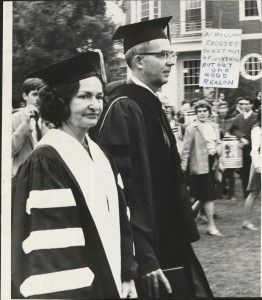
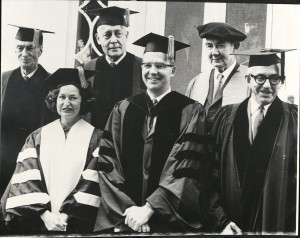
The date in question: Oct. 8, 1967, when Lady Bird Johnson came to Williamstown, setting off protests that made national news.

We were in school barely a month but had amply witnessed the   passions inspired by the war in Vietnam. I’m pretty sure there already had been a gathering at Baxter Hall at which an anti-war football player – a FOOTBALL PLAYER – shouted, “I want action, action, action!” That also may have been when Prof. Robert Gaudino cautioned us children of privilege, “If you don’t go, who will?” meaning those less fortunate, of course.

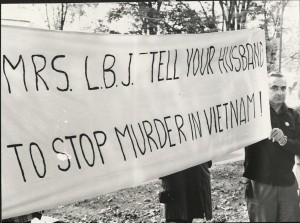
The First Lady’s presence at the fall Convocation had nothing to do with the war. She was invited to receive an honorary degree and help celebrate the opening of Williams’ pioneering Center for Environmental Studies. Yet the protesters were out when she was escorted into Chapin Hall by President Sawyer, one group with a banner urging her to tell her husband, “Stop Murder in Vietnam.”

A half century later, I’m not sure whether I sat in the back of Chapin or on the narrow balcony above. But I vividly remember being among a group of fellow freshmen who surprised me with their…let’s call it fervor. One of our classmates – no longer with us, sadly – had been emotional but level headed in late night political bull discussions in the dorms. When Lady Bird got up to speak, however, he seemed overtaken with rage as he booed and shouted out. At later protests in Washington, the popular chant was “Hey, hey LBJ, How many kids did you kill today?” I can’t remember what it was at Chapin but from our distant perch the First Lady seemed to be shaken, perhaps to tears, as dozens of students marched out of the hall. I was left shaken too, by the possessed look of that one classmate in particular. Passion for a cause was totally legitimate, of course, and a case could be made for making life uncomfortable for those behind policies leaving thousands dead and vast lands devastated. But his demeanor seemed to leave no room to ponder any thought, including very basic issues: Were these tactics effective? Might they even be counterproductive? Issues that resonate around protests to this day, of course.       

Anyway, that was my perspective. The computer now shows us others.

Start with newsreel footage from outside and inside the hall.

Then a handwritten record of Lady Bird’s activities that day, to the minute.

Finally, the First Lady’s own thoughts, in her fleshed-out diary.

Read that, please. You’ll learn that she was well aware of the protesters … but also latched on to other signs outside Chapin, particularly one stating “MAY GOD GIVE LBJ STRENGTH TO CONTINUE HIS COURAGEOUS STAND ON THE PRESERVATION OF PEACE.”

Inside, she scanned the audience as we sang “America,” noticing that the front rows were filled with robed seniors.

“As I saw a white arm band on the first one, I was not prepared for it. I felt a quick pulse of emotion in my throat. I counted another and another. These were symbols of mourning for the war in Vietnam…

“When I was introduced, everyone rose, and it was at this point that some of the graduating class walked out….But the college had its own rebuttal….everybody standing so long and cheering so loudly that their departure was scarcely noticed and they must have felt rather flat. I was both touched and humbled by President Sawyer’s citation.”

From the podium, “I tried to look straight into the eyes of the students in front of me, and from one to another as the speech progressed, and I certainly spoke with passion if not expertise.”

Before and after the Chapin Hall turmoil, Lady Bird’s visit was removed from the public glare, putting her “far from the madding crowd,” she noted. Under the hosting of President Sawyer and Prof. James MacGregor Burns, a foremost scholar of the U.S. presidency, she was taken up to Mount Hope Farm to view the fall foliage, toured the Clark museum to see its Renoirs and bronzes, and was the guest of honor at a dinner at Williams’ version of the White House.

She concluded in her diary:

 “How would I evaluate a day like this? Probably a mistake on balance, because what I had done is provide a vehicle for the dissenters, who were a minority, to get inches in the paper and minutes on the television screen…I was their bait—their creature—for the day.”

She had tried to praise a good cause, as she saw it, but “the louder voices of hate and anger shouted it down.”

“How did I personally feel as I walked among the picketers? Cool and firm and determined to maintain dignity. But through every pore, you sense sort of an animal passion right below the surface.”

“All in all, I guess I lost this round. Lyndon called—distressed—‘I just hate for you to have to take that sort of thing.’”

Perhaps, then, such protests contributed to Johnson’s eventual decision not to run for reelection, though chaos within the Democratic party would contribute to the election of Richard Nixon and the rest, as they say, is history.

Along the way, 11,363 Americans were killed in Vietnam by the end of 1967, 16,899 in 1968 and 11,780 in 1969, the deadliest period of a war that claimed 58,000 American casualties and many times more than that, of course, among the Vietnamese. 

Ethics and Leadership as Essential 21st Century Skills: Reflections on 45 Years of Teaching and Learning – Peter Clarke, Williams ‘71

The question is as old as the origins of philosophical thought. “Can virtue be taught?” In a dialogue called the Meno, Socrates questions a young man named Meno concerning his definition of Virtue. According to Plato, after a series of frustrating questions, Meno throws up his hands saying that there is no way for the “ignorant to ever attain knowledge.” (Teaching With Your Mouth Shut, Donald Finkel p.34) In fact, Meno challenges Socrates entire approach to philosophical inquiry asking:

“How will you look for it, Socrates when you do not know what at all what it is? How will you aim to search for something you do not know at all? If you should meet it, how will you know that this is the thing that you did not know?”

It would appear that American education has answered Meno’s question with the resounding conclusion, “You can’t!” Except for a handful of independent schools large enough to offer departments and courses in religious, philosophical, and ethical studies and a few entrepreneurial, public school teachers who have found innovative ways to integrate ethical explorations into traditionally framed courses in history and social studies, a comprehensive approach to instruction in ethics and leadership is totally lacking in American schools today.

This is surprising given the fact that much of the early history of American schooling was grounded in an exploration of core virtues as the focus of elementary textbooks designed to teach students to read. “In early America, parents assumed a teacher would teach from a Christian perspective. Other than the Bible, the McGuffey Reader was the most read book in 1919. This popular text used biblical examples to teach character, morals and ethics. Instruction in morals, honesty, compassion, respect, and responsibility were taught.” (Historical Review of Ethics Education in America, Jimmilea Berryhill DPhil, Dlitt)

While there are clearly many reasons for the current absence of direct instruction in ethical discourse in schools, the drivers for this change would have to include the growing religious pluralism of American culture, the emergence of a more secular society, and the culture wars that have shaped social and political discourse since the 60’s. In short, the cultural common ground that made the teaching of ethics possible crumbled under the weight of diverging values, lifestyles, social roles, and religious beliefs. One can see this in the attempts made by teachers and curriculum writers during the past 40 years to find creative ways to maintain ethics as a curricular focus in the guise of “value neutral” programs like Values Clarification, Decision Making, Leadership Development, Civic Education, and Moral Reasoning .

It is interesting to note, however, that at the same time that the formal study of ethics began to disappear from the curricular landscape, progressive educators began to advocate for the inclusion of internship, service and leadership programs as a means of developing moral character and a sense of civic responsibility within students. The philosophical rationale for this approach finds its first expression in the work of Aristotle who “supposed that man became virtuous by doing the act itself rather than by pedagogical methods.” Echoing this theme, educational theorist R. J Nash in his book Answering the Virtuecrats (1997) “stated that true character showed through contact with others who served as mirrors to provide insightful glimpses of individual character in practice.” (Historical Review of Ethics Education in America, Jimmilea Berryhill DPhil, Dlitt).

Perhaps the most fully realized program of leadership development in the 20th century was developed by Kurt Hahn, the founder of the Gordonstoun School in Scotland during the 1920’s. Hahn believed that the development of leadership skills, personal courage, and civic responsibility could only be accomplished through an immersion in emotionally intense, physically challenging, and purposefully experiential learning experiences like sea rescue and firefighting training, outdoor challenge programs (think Outward Bound), and an educational community grounded in mutual service and personal responsibility.

For Hahn the road to leadership must afford every student “an intense experience surmounting challenges in a natural setting through which the individual builds his sense of self-worth, the group comes to a heightened awareness of the human interdependence, and all grow in concern for those in danger and in need.”(Outward Bound USA, Josh Miner p. 34) Today, national leadership programs like Outward Bound and the National Outdoor Leadership School (NOLS), as well as, numerous outdoor leadership academies throughout the United States including initiative/team building programs like Project Adventure, all have their philosophical and pedagogical roots in Hahn’s work.

For Hahn schools needed to promote a holistic approach to leadership development that was grounded in a challenging and rigorous approach to knowledge acquisition, inquiry and self-discovery, emotional and physical well-being, personal and social responsibility, empathy and compassion, social collaboration, and personal reflection.

For these goals to be meaningfully realized, Hahn believed it was essential that schools create real-world opportunities for students to serve their school and their community, to connect with and explore the natural world, to engage in inquiry-based, applied learning experiences, and to live and work within the context of highly interpersonal communities that upheld and fostered the highest standards of personal character and social responsibility.

If all of this sounds a bit familiar, perhaps it is because during our years at Williams, Robert Guadino, Professor of Political Science from 1955 to 1974 inaugurated two transformational learning programs – Williams in India and Williams at Home. Guadino believed that, “It is strangers who have the most to teach us; we are assured by our loved ones, but we are taught by outsiders.” (Robert Guadino, “Silence is Suspect”) Up to the very end of his life, he continued to teach, mentor, and inspire his students, often holding classes in his home because he was too sick to get to his classroom.

Throughout his career, Gaudino argued that Williams should “actively promote a range of experiences that have the creative potential to unsettle and disturb” as part of a program of “uncomfortable learning” based on the “unsettling experience.” (Read source.)
“By challenging the notion that public, intellectual engagement should or could be divorced from the private realm of students’ personal background and experience, Gaudino required his students to confront uncomfortable differences and learn through contrasts – for example, between their assumptions and their conclusions, between themselves and others of different social, racial, and ethnic backgrounds, between modern and ancient thought, between the values of public institutions and those of the private home, and even between the different liberal arts disciplines themselves. With insight, discipline, and humor, Gaudino facilitated student confrontation of these contrasts both inside the classroom and outside Williams, in places as diverse as Iowa, India, Appalachia, and Detroit.” (Read source.)
In his short essay on teaching and learning, Silence is Suspect, Professor Guadino observed that, “{Higher levels of knowing} all involve encounters with difference. That is what they share, a brush with something or someone different. {Some feeling of} dislocation sets them apart {from the safety and security of one’s personal world-view}. {In varying degrees}, pain and discomfort are the {the essential roots} of an education – to be in touch with or in dialogue with difference, really up against it. The more varied the difference, the greater the possibility of being educated. Real education mistrusts what we are. It must, in order to be education… Success in pursuit of education is neither natural nor easy…. So, let us not confuse {a comfortable} education, with truly learning anything…”
It’s hard to imagine a fully realized 21st century education that does not fully engage students in the often uncomfortable and challenging process of engaging in difficult and often contentious ethical discourse with others, of compassionately confronting the diversity of the lived experience that defines each of us.

In my final years in the classroom, my students passionately wanted to explore together essential and enduring questions like:
➢ Where do our moral values come from? Are values universal and unchanging, embedded in the very fabric of existence, or are they the subjective constructs of human thought, defined and shaped entirely by their cultural and historical context?
➢ What is the good life? What is right conduct? Is there an ultimate purpose/meaning to life? To what extent are our lives shaped by genetic and/or environmental factors or are human beings free to shape their own destinies? Why is the answer that each of us gives to these questions profoundly important to the present and future course of each of our lives?
➢ Should scientists be held accountable for how their research is applied? Is there any science not worth pursing because of how it might/could be used? Is science blind to moral and ethical judgment? Should science have a conscience?
➢ Is “Might” right? What are the obligations of the powerful or the “haves?” What is the duty of an individual to the community? What is the duty of the community to the individual?
➢ Are we in debt to anyone or anything for the bare fact of our existence? If so, what do we owe, to whom, or to what? And how should we pay?
➢ How should we define and pursue justice—is justice a relative or absolute quality? How do we make our political, social, and economic life reflect our deepest values?
➢ What are the characteristics of authentic leadership? What does society expect from its leaders? What role do ethics play in leadership? How do we judge whether our leader’s goals and actions are moral?
➢ What is transformational leadership? Can one person really make a difference? Are great leaders born or a product of their times?
Given the current trajectory of 21st century American political, economic, and social life, it is becoming increasingly clear that fostering within young people the capacity to engage in honest, ethical discourse must be a cornerstone of every school’s instructional program. Central to achieving that goal is giving students the opportunity to envision their future, to consider the implications and meaning of the systemic forces that are driving their lives forward.

Principled leadership in this context means giving students the opportunity to actively shape their future, not simply live through it. It is essential that we provide young people with an education that fully embraces the recognition that, “Human survivability and creating new concepts of civilization are inextricably linked.” (The Meaning of the 21st Century, James Martin, page 13)
If we are to prepare students to meet the challenges shaping their lives, then ethical, philosophical, and even religious study need to reclaim their rightful place in today’s high school curriculum – not to mention the central role that creative thought must play in every young person’s education.

America today requires school cultures that both demand of and foster within every student the capacity, “to follow what one believes to be the right course in the face of discomforts, hardships, dangers, mockery, boredom, skepticism, and impulses of the moment.” (Hahn) Schools need to be places where everyone is told from the start that they are “crew not passengers,” where the journey, however uncertain at times, is everything, and where the critical ingredient for success is the personal cultivation of courage, perseverance, and honesty.
In the end, a truly 21st century education must speak to the richness and complexity of the human spirit and the interpersonal/cultural bonds that make us truly human.