Remembering Our 25th


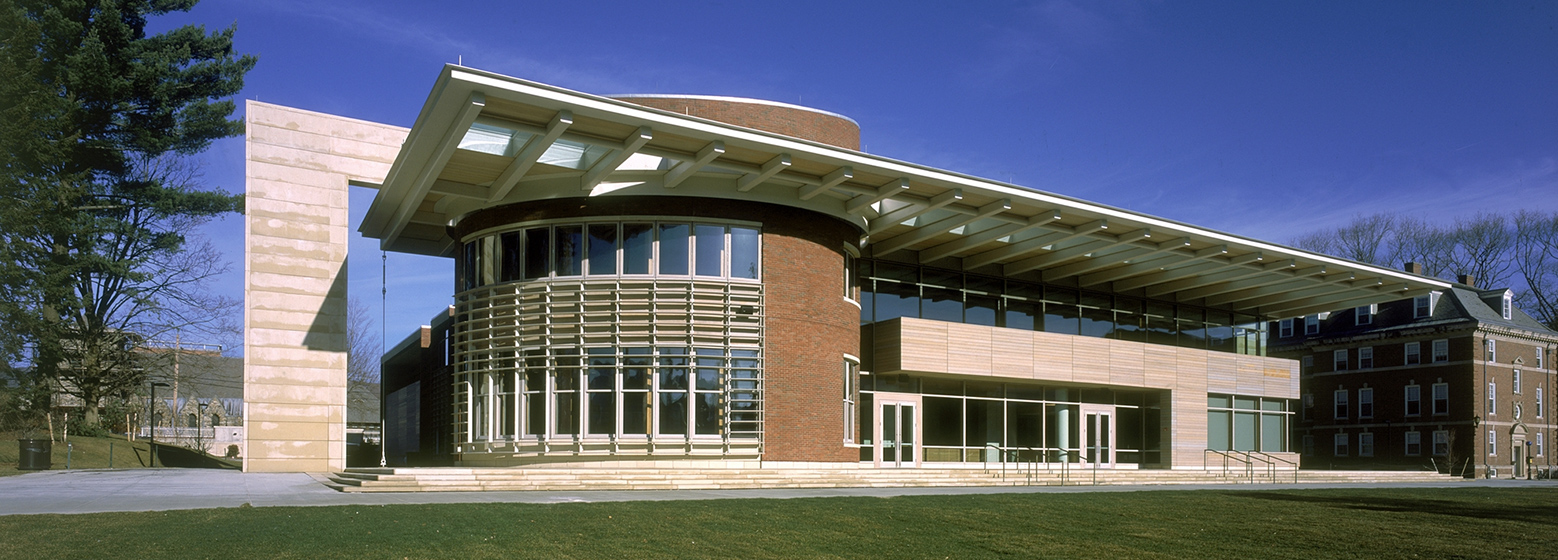
Williams students continue to benefit from our Class Gift,which endowed a lecture hall, scholarships, and our Public Affairs Forum.

Our 25th Reunion book contained essays from several classmates. Some are reprinted here, with their permission; some have been updated.

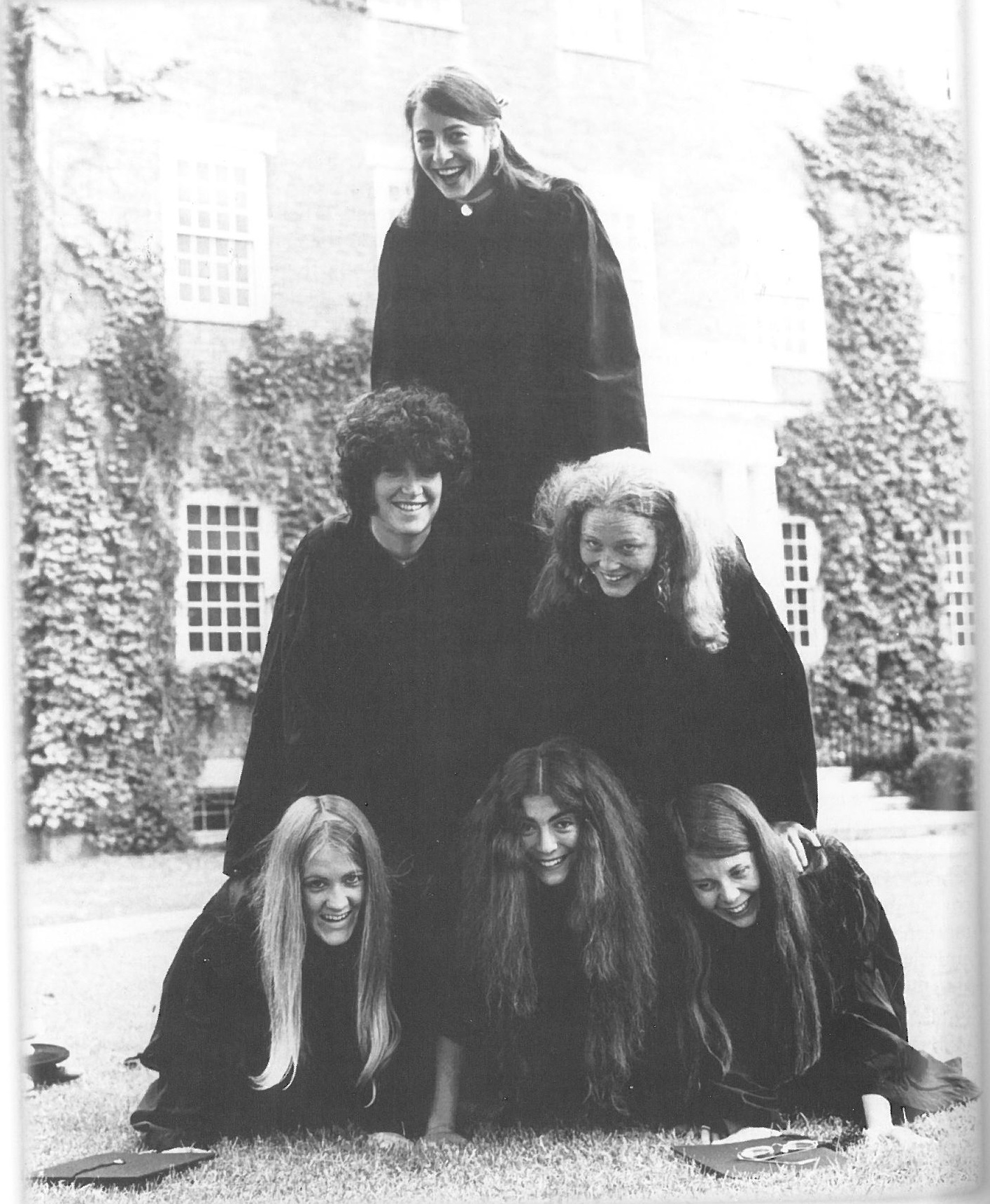
Co-Ed Reflections

Dean McIntire reflects on co-education:


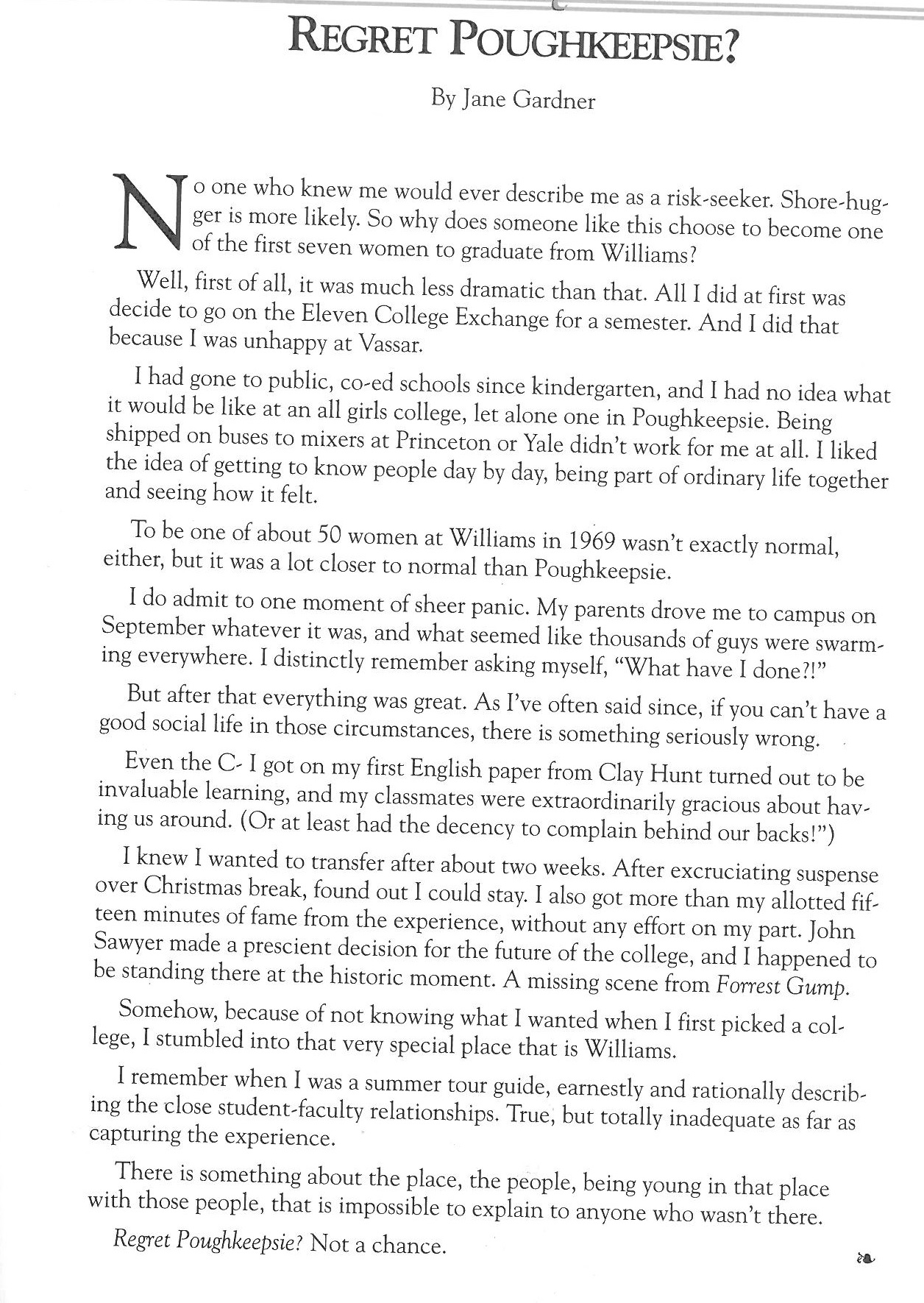
This essay by Jane Gardner appeared in our 25th Reunion Book:

Dean Hyde’s Advice

Advice to Freshmen       Advice to Returning Alums


Dean Hyde has also described traveling to Williamstown as an undergraduate.


He passed away on March 28, 2024; the Record summarized his time at Williams.


Welcome Videos

Class President Steve Brown, Vice-President and Reunion Chair Rob Farnham, and Webmaster John Chambers welcome you to our 50th Reunion Website.


Stroll down memory lane with Steve.   Rob tells us why he’s participating in our 50th Reunion.   John asks us to do three things.


Rob also welcomes us to the web site,


shares his thoughts on why you should come back,


and on the power of reconnecting.


But wait — there’s more!  We also have welcome videos from


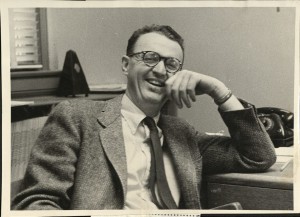
Richard Rouse


The following thoughts were shared by John Ackroff:

I first met Richard Rouse late in 1967. Introduction to Psychology was taught at that time by dividing the semester into quarters and having a different faculty member take each piece and talk about his area of interest. Richard went last, and spoke about memory. At the end of his first lecture, I asked if there was any work I could do with him, since I found the topic, even with that bare exposure, fascinating. The answer was “not now,” but I was still interested. I next had him as an instructor in the spring of 1969, for Experimental Methods.

In the fall of 1969, I changed my major from Chemistry to Psychology, due mainly to Organic Chemistry, and took, among other courses, Theories of Memory and Thought. This was an amazing experience. When I described the course to some of my Rutgers colleagues, they were astounded that anyone would even attempt something of that scope. In the first third of the semester, we read and discussed Hebb’s Organization of Behavior, published in 1949, describing the neurological underpinnings of learning. At the same time, we were reading the first six chapters of Freud’s The Interpretation of Dreams “in the background.” The second third of the course was an in-depth study of Chapter Seven, in which Freud explains how he thinks dreams work and their role in our mental lives, using the same set of questions the folks at Austen Riggs used. The third part of the course was reading and discussing Ulric Neisser’s relatively recent Cognitive Psychology.

In the summer of 1970, I had an NSF Summer Research grant, and we worked on an experiment to understand the types of encoding strategies that we use in short term memory. Conrad (who Richard knew from one of his stays in England) offered evidence that we use an acoustical scheme, but we showed that meaning is more important. It led to my first publication. One of two afternoons each week, the Summer Research students would get together with some of the faculty in the Math Lounge on the second floor of Bronfman to talk about what we were doing, what progress we were making, what obstacles we were facing, etc. It was during one of those sessions, when someone was talking about trying to solve some particular problem that Richard said “Ah, but you’re asking the wrong question.” I have often said that this is probably the most valuable and important thing I learned at Williams. If you don’t ask the right question, you’re pretty much guaranteed not to get the right answer.

In the classroom, Richard would often give the derivation of words, citing their Greek and Latin roots, and tout “the value of a classical education.” After Commencement, I found him, handed him my diploma (which is in Latin) and asked whether or not I had all the rights, privileges, and honors. He expressed surprise that it was in Latin, but was able to give me a decent reading.

After I left for graduate school, the intervals between our correspondence became longer and longer. We were re-united at the dinner for the dedication of the new Science Center in the fall of 2000. Email made keeping in touch much easier, and I also started visiting Williamstown a few times a year for various reasons, which gave us the opportunity to get together. Karen and I looked forward to these visits, and would make sure to schedule one whenever we could. Karen’s lab used a procedure similar to the one Richard used in Clark Hull’s lab at Yale for a study of sham and esophageal feeding in dogs. One day shortly before one of our visits, her lab director mentioned something about the Hull study, and she said to him “Well, let me know if you have any questions; I’m having lunch with the third author this weekend.”

I’ll finish by including an email message from October, 2002. I had been in a bicycle accident, separating my shoulder and fracturing several ribs while trying to avoid hitting a groundhog head-on, and wrote him about it, because I remembered him telling us that one of the authors of the Skaggs-Robinson hypothesis, which has to do with interference in memory, was killed in a bicycle accident. I can hear him when I read it, and it’s a very nice illustration of differences between episodic and semantic memory (remembering things about our lives vs. things we learned) with respect to permanence. With his permission, I read parts of it to my Cognition students at an appropriate part of the semester:

J. WOW.
The varmint might indeed have thrown you. Shoulders take a long
time, but better than head first.
I had 2 accidents like that as a teen ager. I was coming down a
hill when a car coming up made a left turm in front of me. Coaster rear
brakes were what we had back then. Braking and turning made me go into a
feet first, wheels first slide. Avoided the car, got a real fear
experience, but only skin scrapes. . The other was worse. That time I hit a
car’s left rear fender and flew thru the air, spraining a wrist upon
landing. Friend with me said he heard me shout ‘Oh, my bike’ as I flew. It
was almost new and I’d saved for months to buy it at $12 from Sears. Fork
was bent at right angles. Motorist was real nice, didn’t want anything of
me. It was in front of friend’s house, so he & I declined help. My father,
out of work in the depression (hence my need to save for the bike), thought
we should sue, but I said it was my fault.
It was Robinson. Walking on a shopping street sidewalk, he was
knocked down by a student bicyclist. Hit his head. Parhaps 5 or 6 years
later, in ’41-’42, my first year at Yale grad school, I dated a niece of
his widow. Pat something-or-other. I never can retrieve that gal’s name.
She lived with her aunt, Varly Robinson. Varly was still in a big house in
North Haven. She taught me how to make martinis, manhattans,
old-fashioneds, other mixed drinks, at the parties she hosted for us
psychol students, saying a woman shouldn’t do that. sort of thing. Later,the Marquises bought the house, so I was at parties there again after the war.
Memories, memories. Those events are easy to retrieve. but I had to
go to a book to see what the Skaggs-Robinson hypothesis was. All that came
up was the name. Wonder what became of Skaggs. My ref Hilgard & Bowers,
shows that Robinson published it, giving Skaggs priority. Robinson had
several other publications, and one heard in the Dept that his death was a
big loss to teaching, reserch and theory.
Rib muscles really hurt, even if only bruised. For me, that was a
fall going upstairs with a plate of food at Fielding & Ellie Brown’s. Saved
the plate, hit the ribs on a step edge. Don’t use that shoulder. R.

As he said, “Memories, memories.” He has given us many good ones.

Oxford Trip

March 20, 2020

Dear ’71 Oxford Travelers,

Since we last wrote with an update, so much has changed in the world. Yesterday, we sadly came to the decision with colleagues at Wiliams that we must cancel your pre-50th June Oxford trip due to the globally growing concerns of COVID-19. We are so sorry, this is such disappointing news to share at a moment when that’s all we seem to be receiving.

Sadly, this news likely comes as no surprise to you. Indefinite travel bans and the unknown personal and public health risks of traveling anytime soon were obviously our primary concerns. For Oxford, specifically, our current students at the Williams-Exeter Programme at Oxford have already been sent home, and Oxford University is likely to be closed for an extended period of time. Therefore, even if we were able to and many of you chose to travel in a few months, we could not be certain of any of the planned trip activities happening. We hope this notice gives you plenty of time to change your travel plans for June.

We are in the process of canceling arrangements with all of our vendors, lecturers, and partners in Oxford. We will begin processing reimbursements to each of you for whatever deposits or fees you’ve already paid to the college. We hope to be able to return them to you in the next week by check or directly to your credit cards depending on how you paid us.

Some of you have asked already what might be possible in rescheduling this trip or some other special pre-50th gathering for your class. We can’t know yet, of course, but we will explore possibilities with your class leaders as soon as we’re able to think that way. Rest assured, we will do all we can to help you gather together in fun and meaningful ways through Williams as soon as possible.

We are thinking of all of you in this moment and hope that you and yours remain healthy and safe in the days ahead. We are most appreciative of all you do for each other and for Williams and look forward to seeing you all very soon. Thank you.

Sincerely,

Mark & Kate

Fall 2019 Mini-Reunion

Our Fall 2019 Mini-Reunion was combined with our Presidential Forum.  This provided us with the opportunity  to learn about some of the inner workings of Williams.


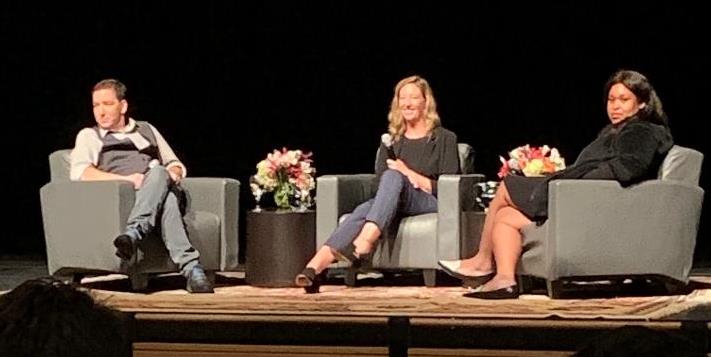
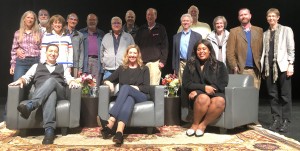
We met September 13 – 15, with a “pre-event” on the evening of Thursday the 12th — a discussion of “Digital Technology, Social Media, and Today’s Political Climate” sponsored by the Class of ’71 Public Affairs Forum, the Cohan Family Forum, and the Lecture Committee from 7:00 to 8:30 PM in the ’62 Center for Theatre & Dance.


The discussion was reported on in the September 18th issue of the Williams Record.

Friday, September 13: 

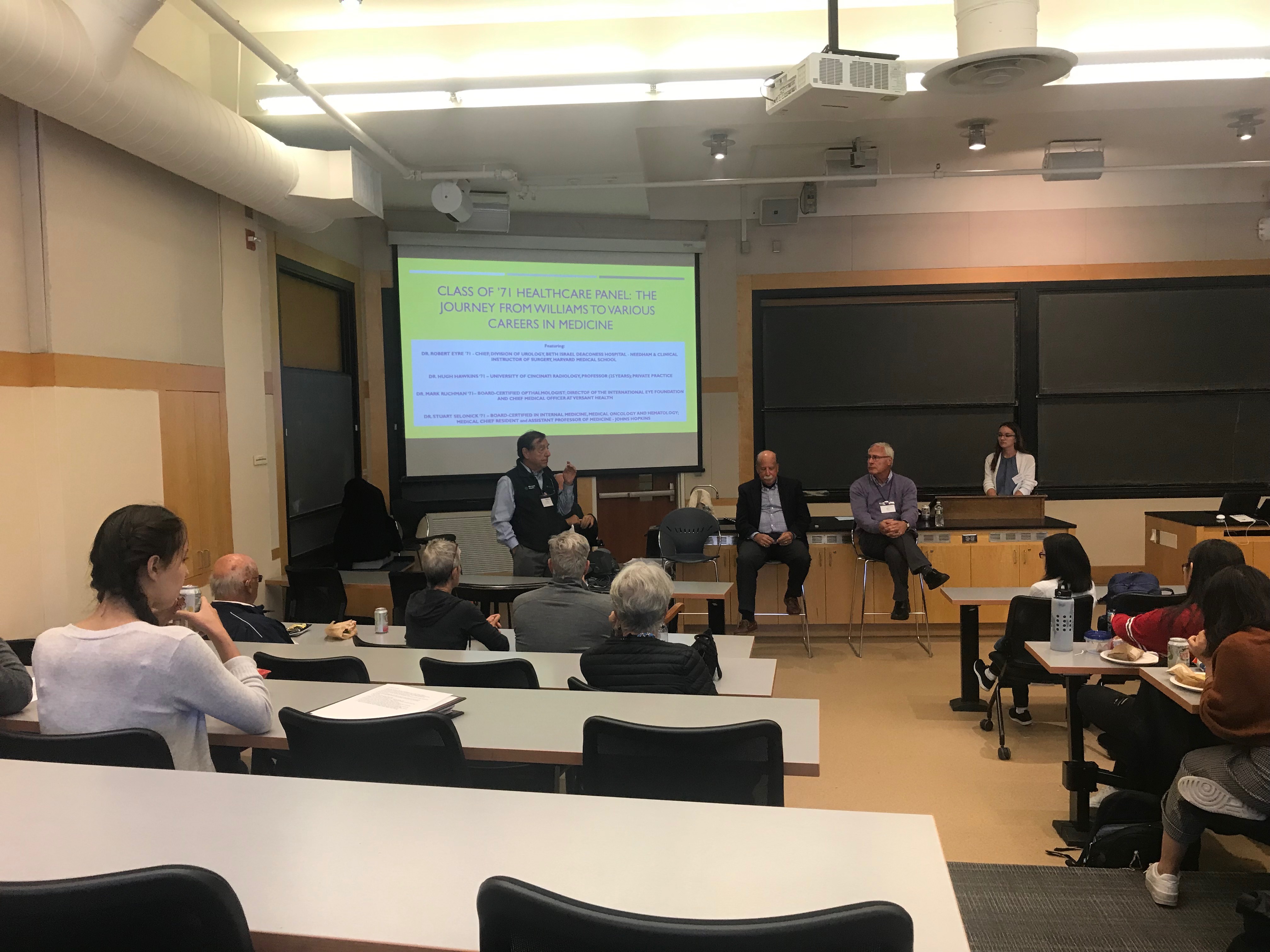
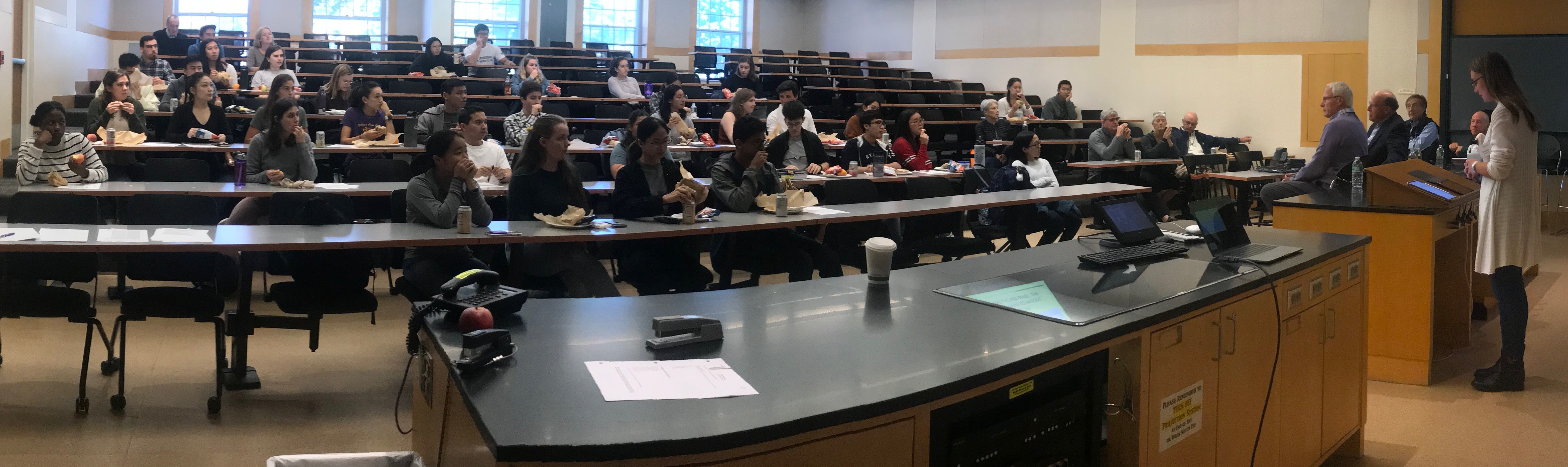
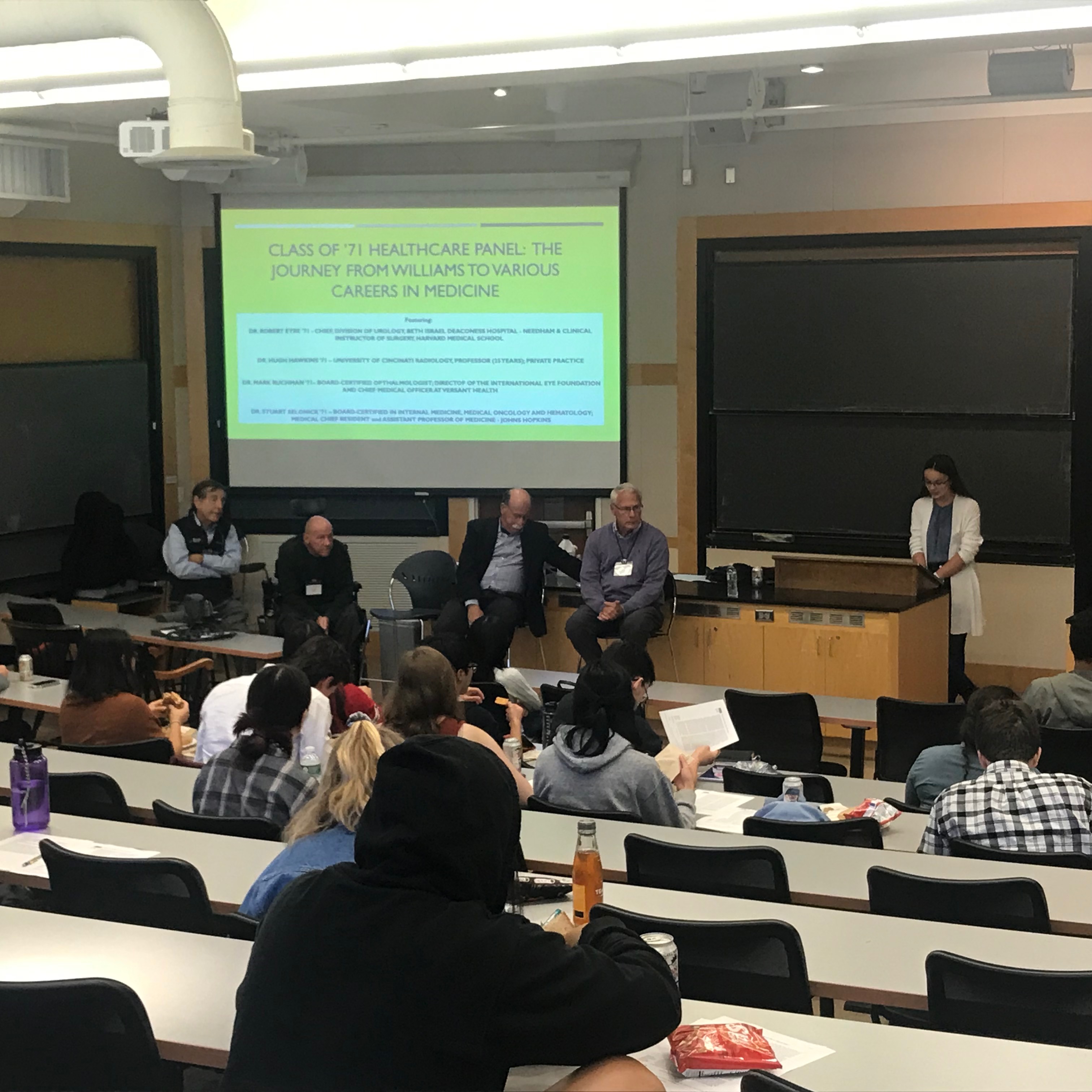
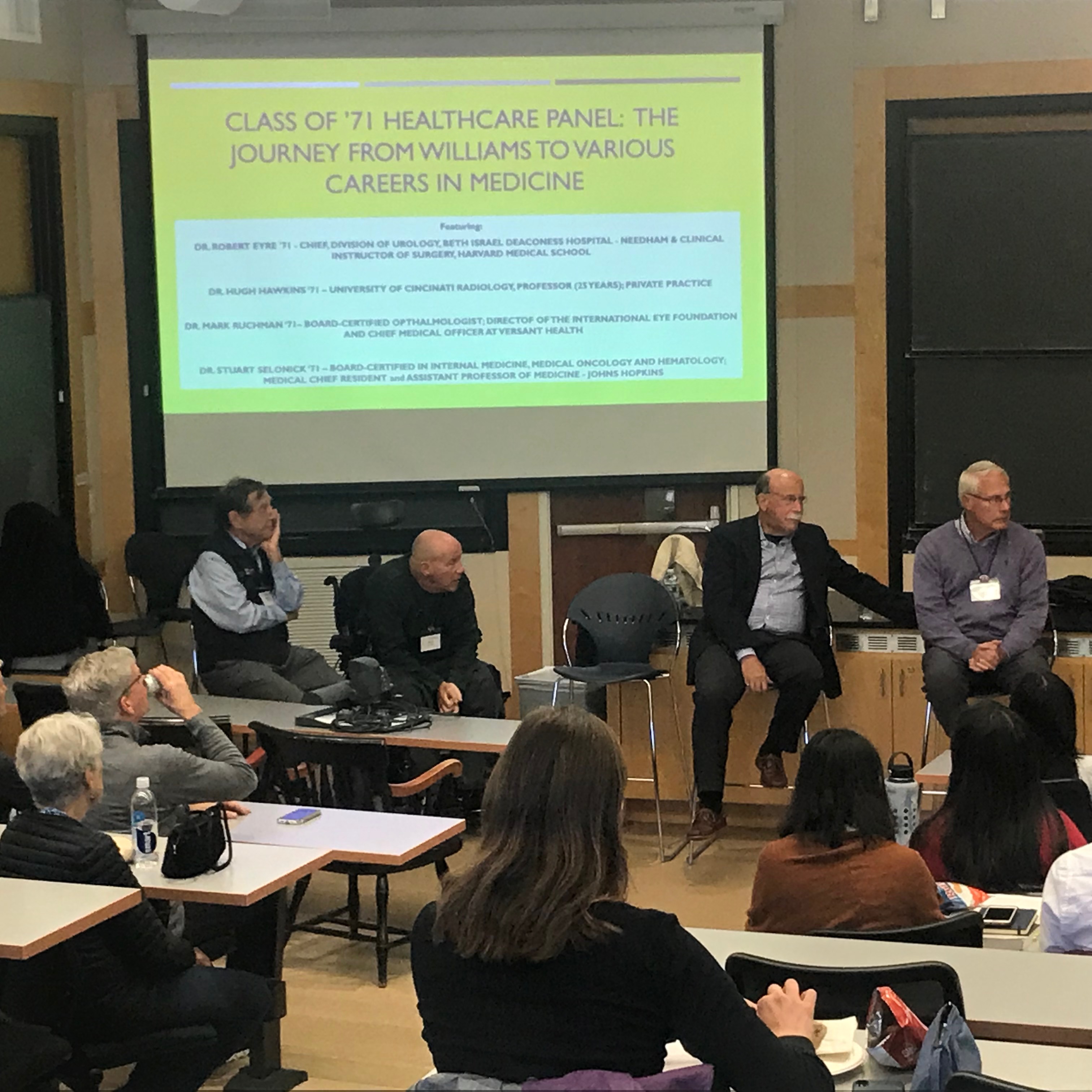
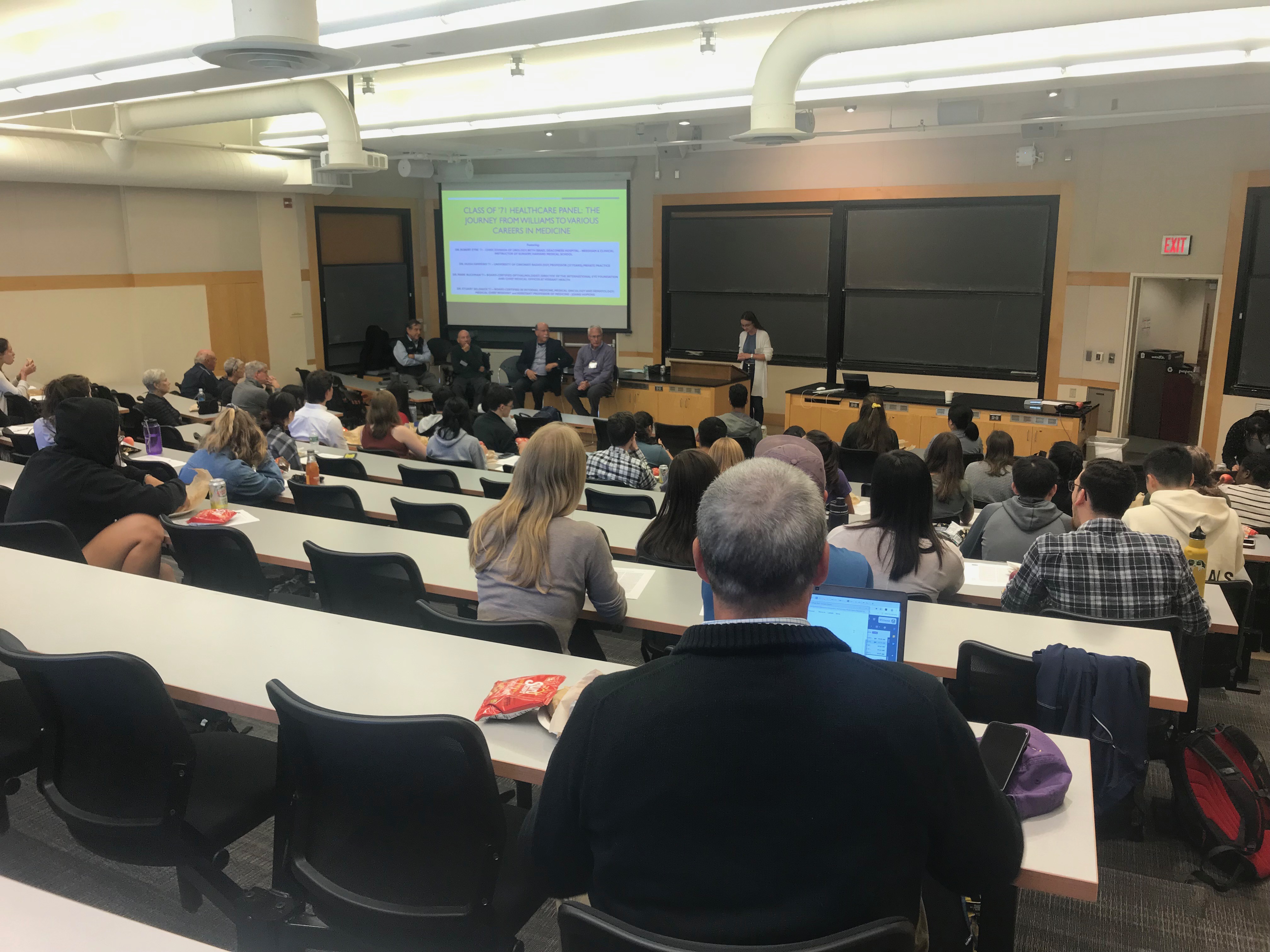
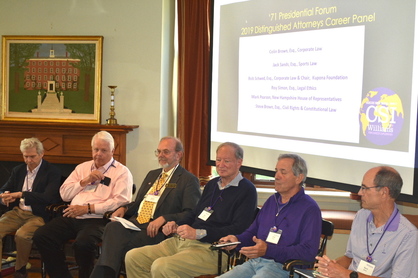
12:00 – 1:30 PM:  Separate lunches with students organized by Career Counseling with doctors, educators  (teachers and administrators), and attorneys.  Classmates who aren’t panelists are also invited.

    • Doctors:  Bob Eyre, Hugh Hawkins, Mark Ruchman, and Stu Selonick; Wege Auditorium, Chemistry Building
    • K – 12 Educators:  John Chambers, Peter Clarke, George Ebright, and Kent Rude; Lewis Room, Mears House, 95 Park St.
    • Lawyers:  Colin Brown, Steve Brown, Mark Pearson, Jack Sands, Bob Schwed, and Roy (“Andy”) Simon; Faculty House (Lower Level)
       

      See more photos

2:00 – 3:30 PM, Presentation Room, Weston Hall:  Session 1:  Williams Today – Who constitutes the Williams student body and faculty today?  How are they selected, and what are the challenges in getting who Williams wants (tenure, housing, and financial aid, etc.)?  What are academic and student life like today?

3:45 – 5:15 PM, Presentation Room, Weston Hall:  Session 2:  Williams Finances – What do the College’s finances look like?  What is the vision for Williams over the next 25 years, and what resources will be required to accomplish it?  Topics include tuition and financial aid, faculty recruitment, and endowment management.

6:00 – 9:00 PM, Faculty Club:  Cocktails and dinner at 7:00 with President Maud Mandel who will  talk about the Strategic Plan and questions about the Plan and from the afternoon sessions.  Business casual attire; jacket recommended for men.

Saturday, September 14:

8:00 – 9:00 AM, Faculty Club:  Breakfast and committee meetings

9:15 – 10:45 AM, Paresky Center Auditorium:  Session 3:  Speech on Campus – Provocative speech, offensive speech:  how can Williams facilitate productive, open debate on controversial issues?  How does the College ensure a wide range of ideas and beliefs are shared?
 
Here are some suggested readings for this session:

11:00 AM – 12:15 PM, Paresky Center Auditorium:  Session 4:  Arts on the Campus & Beyond – What does an education in the arts look like today, both inside and outside of the classroom?  How do the arts and humanities remain vibrant in an era of pre-professionalization?  How does Williams take advantage of its location in the arts-saturated Berkshires?

12:30 – 1:30 PM, Room 3, Griffin Hall:  Lunch at tables with faculty members/coaches and students

12:30 – 2:00 PM, Ramunto’s at The Log:  Lunch Meeting of the Reunion Fund Committee

1:30 – 6:00 PM:  Free time, with a couple of organized events from 2:30 to 3:30:

    • Meet in the Schow Science Library Atrium for private, small group tours of the new Science Center by Tiku Majumder, Barclay Jermain Professor of Natural Philosophy and Chair of the Science Center, and other faculty members. They’ll plan to visit labs and include some students, with plenty of time for Q&A.
    • Meet in the WCMA Atrium in Lawrence Hall to join Deborah Brothers, Costume Director, Designer, and Lecturer in Theatre, for a mini course in the Williams College Museum of Art (WCMA) Rose Study Gallery. This interactive session includes close looking at textiles, photographs, and paintings in the WCMA collection with a focus on costume history and detective work.

Also, the Clark Art Institute has an exhibit “Looking Twice at Renoir and O’Keeffe (Ida, not Georgia)” which has received very good reviews.

6:00 PM – 9:00 PM, the new Williams Inn:  Reception with Class dinner at 7:00.  Business casual.

We will have a videographer present to capture thoughts about why we come back to Williams, some of our fondest memories (veridical or not), etc., so think about what you might want to say.

Sunday, September 15:

8:00 – 9:45 AM, Faculty Club:  Class committee meetings

9:00 AM – 10:30 AM, Faculty Club:  Brunch with Maud – more Q&A with  Maud based upon the sessions during the weekend or discussions among classmates