
 |
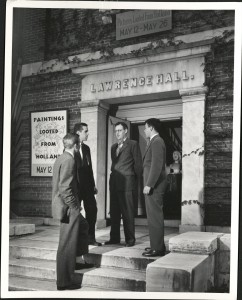
A diary belonging to Professor Faison has been donated to the National Archives by the Monuments Men Foundation. The diary documented his time as director of the Central Collecting Point in Munich, where he oversaw the return of artwork stolen by Nazis.
The following thoughts were shared by Bob Eyre:
S. Lane Faison
I count myself among the many fortunate members of our class who were told that Art History at Williams was almost a required course. Once you came under the spell of the Faison-Stoddard-Pierson triumvirate, you rarely could or wanted to escape. Lane Faison was, to me, the quintessential embodiment of what made Williams great – a formidable intellect, a teacher with encyclopedic command of his subject, a brilliant lecturer, a kind but pointed critic, and a man with infectious enthusiasm for his subject and for his students.
Before his long and distinguished career at Williams, he was a Lt. Commander in the US Naval Reserve. He wrote the official top-secret report on Hitler’s collection of stolen art. Five years later, he supervised the return of those works under the Department of State (Monument Man). He was awarded the French Legion of Honor for this effort, which he proudly wore in his jacket lapel.
After taking his introductory course, I decided to double major in art history and I took every course that Lane offered. His course on critical writing (H353) was, by far, the most influential one I ever took at Williams. He graciously hosted the classes at his home on Scott Hill Road, where the atmosphere was conducive to spirited discussions and interactive learning. He nurtured his students’ ability to see and appreciate works of art in all genres and to crystallize their thoughts in succinct, economical prose. Nothing would make him happier than to know that his insistence on quality writing has immensely impacted all of the scholarly writing and editing I have done in my medical career.
When the college went on strike, Lane felt that it was important for influential alumni in NYC to hear directly from students about the motivations and constructive activities that were occurring on campus, and I was honored to accompany him to the Williams Club to participate in a panel discussion. His presence and support of the students played a huge role in calming the fears of older alumni, assuring them that Williams would emerge a stronger institution.
Lane’s wife, Jodie, was a lovely and gracious hostess. To this day, I remember a beautiful luncheon they invited me to at their home just before graduation where she served an asparagus salad (which I still detest). It is a tribute to my love for both of them that I somehow managed to eat it.
Whenever I returned to Williamstown for reunions or to visit our kids during their undergraduate years, I always looked to see if Lane was walking down Spring Street, looking dapper in his tweed jacket. He had a prodigious memory and seemed to recall our names and details of our lives after Williams with great accuracy. He passed away in November 2006, just short of his 99th birthday. He will always be remembered as one of the giants in the history of Williams.