Winter Study 2020

Six of our classmates taught Winter Study courses in 2020 — probably more than any other class!  Subjects include Ethical Issues in Surgical Care (Bob Eyre);  Neuroscience of Learning (Judy Allerhand Willis, supported by her husband Paul Willis); Entrepreneurship, Negotiation, and Investment (Bob Schwed); and Mock Trial (Dave Olson and Steve Brown).
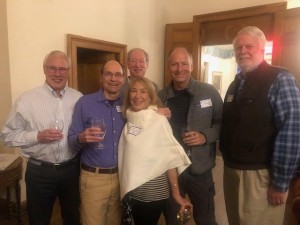

Bob Eyre, Steve, Judy, Bob Schwed, Paul, and Dave.

Some thoughts from our esteemed faculty:

Judy Allerhand Willis:

When I return here to teach winter study, I feel that excitement when awakening each morning to go to class (but this time refreshed from not having stayed up so late)!  The students are my teachers, challenging and enhancing my ideas with their insights and questions. I feel their optimism as well as their concerns. They appreciate the bubble of the purple valley and also recognize the privilege and responsibilities of the opportunity they have been given. They impress me by their goals to give back, care, be grateful, and continue questioning, exploring, and embracing their future challenges and opportunities.

   
    She’s done this before!
Bob Eyre:

I am thrilled to be in Williamstown for the month of January as an adjunct professor teaching a Winter Study course on Ethical Issues in Surgical Care. I conceived the course as a discussion of case studies that I put together to examine the many challenging situations that surgeons encounter from an ethical perspective. The main topics include surgical professionalism, the surgeon-patient relationship, conflicts of interest, substitute decision making, end-of-life issues, confidentiality, and ethics of access. For each of these, I prepared between 5 and 10 case studies that we dissect in detail in class. We will read and discuss Atul Gawande’s book, Being Mortal. I also structured this as an intensive writing course and each student will prepare four papers during the month reflecting on many of the ethical issues raised in the case studies. I edit these very carefully and meet with the students to discuss my comments and suggestions.

I have a phenomenal group of fourteen pre-med students in the class, quite evenly divided from first-years to seniors, with an equal number of men and women. I also have some students and Williamstown residents who are auditing the classes. The students have wide-ranging interests – many are on varsity teams, three play in the Berkshire Symphony, and all seem to be very intent on medical school after a 1-2 year break for research, clinical experiences, etc.

The range of topics explored in the papers has been impressive, including the influence of big pharma on physicians, concurrent and ghost surgeries, informed consent issues, the ethical obligation of hospitals to provide physician health programs to combat physician burnout, obligation to disclose genetic testing results, ethical conflicts in reporting abuse, and mandatory vaccination laws to name a few. Many of the papers have been truly exceptional.

It is really gratifying to see so many of our classmates sharing their time and expertise as adjunct Winter Study professors. It is a priceless gift that we are passing on to this generation of incredible Williams students.

 
Bob Schwed:

I have 30 students in my venture capital class, eleven of whom are on the men’s hockey team. I am uncertain as to whether that team concentration is a reflection of the entrepreneurial spirit of hockey players or a collective judgment as to the rigor of the course. Once I first proposed the course four years ago, I thought I would have many aspiring lawyers as I had taught a version of the course in law school as an adjunct professor. This year I do not have any students who have indicated that law school is in their future. To a person, the students want to start businesses, join early stage companies or be venture capital investors.

The highlight of the course, I believe, is the various guests that participate in class discussions and then meet with students to address whatever topics are of interest to the students or the guest. Two of our entrepreneur guests (and Williams alums) were Mark Wallace, the founder of Parlor Skis, which sells custom made skis, and Mary Imevbore, the winner of the Williams business plan competition in 2018, whose company sells wigs and hair extensions online primarily to Afro-American women. Mark also happens to be Dave Olson’s son-in-law.

 
Steve Brown:

David Olson and I had the pleasure of returning to Williamstown in January to teach mock trial. Our course consisted of eight 3-hour sessions divided up as follows: one lecture, five classes designed to help the students prepare for two trials; and the two final trials. We divided our 11 students up into two teams and each would present cases  for both the plaintiff and defendant switching sides in the same case in our final 2 sessions . This year’s exciting case focused on untimely demise of Mr. Gilbertson while trying to scale Mt. Everest. We were ably assisted by Judges Rodney Brown, whose 40 years trying cases made him ideally suited to the bench, and Bob Schwed, whose 40 years of making deals, made him an adventure on the bench for our fledgling lawyers. 

Our 11 students were all bright, engaged, from different backgrounds, and had different interests: first years to seniors, with homes from Massachusetts to Thailand, with majors stretching from math to poli sci, and some involved in athletics from rowers to softball players.  None of the students knew each other before the course, so it was very cool to see each group grow into a team bound by a common goal— winning the trials!! 
 
The most rewarding part for me was to see the students who were very uncomfortable on their feet in the first two classes get up at the final trials and make a seven or eight minute closing or opening argument or doing a direct or cross examination without hesitation and with a good, strong voice. Dave agreed that watching the individuals enhance such skills was rewarding, for we both believe that such skills never fall out of fashion. 
 
Another delight was getting together with other classmates who were also teaching Winter Study courses or in the area to cook, eat and socialize together.  Dave Olson and Steve Latham were our Head Chefs, supported by sous chefs Paul Willis and Judy Allerhand Willis (hot appetizers and dessert) , Bob Schwed cold appetizers), and Bob Eyre (salad). Bob Eyre, Rod Brown and Steve Latham played the role of our sommeliers. Sue and I supplied the kitchen and dining room table. A good time was had by all.  During the month, Bob Eyre also added a recital on the piano.
 
 Our Winter Study gang also enjoyed pizza at the Log with Jack Sands and Jorie and Steve Latham before watching the men’s basketball team beat Amherst in a 62-60 thriller. At the game, we were joined by Doug and Jane Pickard and Jay Healy ’68 in rooting the Ephs on.  Earlier in the season, Gene Bauer joined Steve, Bob Eyre and Doug for the win over Bowdoin, and Bob and Doug for the loss to Colby.

Kennedy Richardson Remembers Professor Stabler

Kennedy Richardson writes:

     Ever since graduation, I have always been known as, among other things, a Physics Major. Frequently with quizzical looks, people would ask “How did you ever get from Physics to managing an equity fund at Fidelity?” So to start near the beginning, when I arrived at Williams, I fully intended to major in Mathematics. Receiving advanced placement into sophomore math, I actually had to work for the first time and received a B+ in the course, my worst performance in math ever. I was devastated. Meanwhile at 8 AM on Monday, Wednesday, and Friday mornings, I was taking Physics 103 with “Papa” Stabler; a kindly, inquisitive, albeit somewhat absentminded, professor.  (My first Physics teacher at Belmont Hill was also someone I had loved and I was deeply honored to give the eulogy at his funeral.)  He would end each class with an experiment, always teaching, but occasionally with catastrophic results. Our favorite was the demonstration of the bell curve distribution with about 10,000 ball bearings. He forgot to place the trap in the bottom of the large glass container — no bell curve, but rather 10,000 ball bearings all over the floor.

     Class and assignments were always a wonderful exploration of some puzzle of the physical universe. What makes a rainbow? Why is the sky blue? And the first of Einstein’s famous thought experiments on relativity: Why do two men in two trains traveling at the same speed next to each other appear stationary? One day Dr. Stabler told us in passing that in Physics you would solve problems, while in Math you would discuss how you might address how one might solve a problem. By winter break I was hooked.  Incidentally, I cannot remember the name of my first Williams math professor.

     For four years, it was always figuring out a wonderfully complex series of puzzles about the physical universe. What is really going on here? What are the two or three key factors driving the phenomenon you were studying? In the end, there was always Dr. Stabler’s recommendation, “Please conclude with a few simple English words to summarize.” Vintage scientific instruction at a classical liberal arts college.

     Outside of class it was four years on the ski team. Fairly consistently on the winter carnival team but a very long way from number one (always John McGill). Plenty of hard work, lots of crashes, and always picking yourself up for the next race. All measured to 0.1 seconds. (More on 0.1 later.)

     By senior year, I loved my major, but knew a career in engineering or academics was not for me. The summer before, a fellowship at Brookhaven National Laboratory had convinced me. Next came Harvard Business School, and in 1973 on graduation, a career in investment management.

     Somewhat surprisingly, picking apart a stock was a lot like doing Physics problems. What are the two or three factors really driving the outcome? Get to a conclusion.  The few simple English words became two — ”buy” or “sell”.  With a diversified fund it was much more multivariable.  How do all the pieces fit together?  While unlike Physics, you could never ignore the human element in security prices.  All those humanities courses really did matter.  Starting a fund at Fidelity in 1985, I was once again measured quite precisely; to be exact, in increments of .01% of return, every 24 hours for 23 years. I have often joked that when they make you a diversified portfolio manager at Fidelity, they give you two things — a Bloomberg terminal, and a cyanide capsule, with one instruction: if one does not work, try the other.

     Managing a fund, like Physics, was a great intellectual game, perhaps the greatest ever invented. You also get to compete against some of the most aggressive and finest minds anywhere. As an added plus they even pay you. There is always a stumble or fall, just like sports (sounds like ski racing) where you have to pick yourself up, learn from the error and go on. I always liked to hire athletes with a great education, most notably my successor, Forrest St. Clair, Williams ’97, Biology major, baseball team.

     So today, I placed a couple of trades on the money I still manage for myself, went to physical therapy for my new right hip (so many happy memories of wearing out the old one) and over lunch I watched a thirty minute lecture from an online refresher course in quantum mechanics. This time, a first time for me, given by a very talented female professor from Purdue exceptionally good at “the few simple English words.”

     So that is how I got from A to B. Some things are constant, and some things change. See you in Oxford, at the 50th, or hopefully before.

Rob Jones’ Story

Biography of Robert N Jones MD MHA
 
At New Trier High School in Winnetka, Illinois I was an All American Swimmer. At Williams College (’71) I swam my freshman year, and was elected co-captain of the freshman swim team. By the end of my first year, however, I became very tired of swimming, having swum competitively since grade school and becoming interested in other activities at college. Although pre-med, I decided to major in English Literature, a decision for which I have remained forever grateful.
 
My interest in medicine arose from observations of my father, a phenomenal physician, beloved by his patients and respected by his colleagues. It was from him I developed a desire to practice medicine and attempt to emulate his keen sense of servant leadership in both private and professional life.
 
My third year at Williams sidetracked me. My winter study project in 1970 concerned the British National Healthcare Service and took me to England. There I learned much about over worked physicians and, at the time, an inadequate style of healthcare delivery. One other side effect of the trip was a consuming desire to travel. I returned to Europe that summer to study German in Salzburg Austria, in preparation for a new career, one in international politics. Instead, I developed an international affair: I met Maria Ludovica Moruzzi, nicknamed Mica.
 
Born and raised in Bolzano, Italy, she could not speak English and I did not know Italian, so we spoke German. Growing up in the South Tirol, her German was perfect, but mine was nascent and hatched in the language lab at Williams. As one can imagine, in my efforts to get to know her, my German got very good that summer.
 
We said goodby in August. That Fall she began her studies at the University of Florence, and I went to Vassar for one semester as an exchange student. To make a long story short, we went our separate ways, but managed to reunite the Christmas of 1971. We got married in her hometown in 1974, after she had gotten her Doctorate in Childhood Education.

By that time, I was in my third year at Rush Medical University in Chicago. My reason to return to medicine was partially to reattach myself to my original dream of becoming a doctor, and partially to secure a better future for a life with Mica. The main reason, however, was to allow me to travel the world with a medical degree, caring for the sick of developing countries under the aegis of groups like the World Health Organization. Along the way, I did have opportunities to work in Kenya, Africa in Medical School, as well as Haiti during my residency in surgery. Mica made it quite clear, however, that international travel to developing countries was a non starter and not what she had in mind.

By my third year in medical school I was intrigued by cardiac surgery. From observatory rooms overlooking the operating theaters at Rush, I watched some of the greatest surgeons in the world. I was hooked. All I wanted to do was become a cardiac surgeon.

Duke University has one of the best residency programs in General and Thoracic surgery in the country. I rotated there as a medical student for one month in the Fall of my senior year. Duke’s chief of surgery at the time was David C Sabiston MD, and he offered me a position for the following year. I had done well in medical school, with top marks in my studies and the award of Alpha Omega Alpha, the honorary medical school society. I was also a father to our first child, David, an even bigger honor.

In 1976 Mica and I moved to Durham, North Carolina. We were blessed with our second child, Juliana, in 1978. I finished my residency in 1985. Those 9 years at Duke were grueling, but formative, and meant to groom me for an academic career in Thoracic and Cardiovascular Surgery. Two years were spent in the lab of cardiac surgeon Andrew S. Wechsler, MD and the cardiac pathologist Robert B. Jennings MD. I published 37 papers and delivered presentations in several national meetings.

In 1985 we moved back to Chicago where I became an assistant professor of Cardiothoracic Surgery at Loyola University Medical Center. That year was spent teaching, operating, and organizing a laboratory. It was too much for the family to bear. I was never home. We made the decision to abandon academia and begin private practice.

We wished to remain in the Midwest, and the best opportunity at the time was a newly developed cardio-thoracic group, East Michigan Cardiovascular Surgery, PC. In 1987 we moved to Midland, Michigan, 30 miles north of Saginaw where the practice resided. I broke off from that group the following year, starting my own practice that grew to a 6 member group by 2000. I was the chief surgical officer of the group, Great Lakes Cardiovascular Surgery, PC. It served the entirety of Mid Michigan. The times were busy and productive.

In 2000 our surgical group joined several groups of cardiologists in the Midland/Bay City/Saginaw area to become a large 30 physician member organization called Michigan Cardiovascular Institute. This splintered for a number of reasons in 2010. Prior to that in 2007, I was asked to start a new open heart program at the hospital in Midland, just four minutes by foot from our home. Thanks to a devoted group of professionals, the practice in Midland has grown to become the busiest thoracic and cardiovascular service in the area, with two cardiac surgeons and one general thoracic surgeon. It is incredibly fun to come to work each and every day. I am surrounded by the best. I remain busy operating, but am looking to retire to something different.

I have held a number of leadership positions, such as President of the Saginaw Medical Society (1998-1999) and President of the Michigan Society of Thoracic and Cardiovascular Surgeons (2017-2019). Getting close to retirement, I know full well that if I wish to maintain my relevancy in medicine, I need to know more about the changes in healthcare from an administrative and leadership perspective. As a result I enrolled in the Masters Program in Healthcare and Leadership at Saginaw Valley State University. I received my Masters in Healthcare Administration in 2018. My plan is to eventually work as a consultant in some aspect of team building and the improvement of the patient experience. Both are areas to which I have devoted my professional career.

Our children, David and Julie, went to high school at Detroit Country Day School. From there, David entered the class of ’97 at Williams, and Julie the class of 2000 at Denison. During our time in North Carolina, Mica received her BS in interior design at the University of North Carolina in Greensboro. In Midland she quickly became a well known and busy contract designer and artist. She has since abandoned interior design and spends her time with her art work. David has gone on to Hollywood where he is busy cinematographer. Julie has her own Barre 3 studio in Washington DC. Both have wonderful spouses, and Mica and I are the proud grandparents of 2 beautiful, energetic boys from Julie and Peer, and one amazing granddaughter from David and Amy.

My free time is spent enjoying time with Mica, our children and grandchildren. I love fly fishing. In addition, I sing at the top of my voice as a choir member of our church. This fall I will be joining the Midland Community Orchestra as a second section violinist.

At the same time, I keep reminding myself that there is nothing wrong with retirement…as long as it does not interfere with life.


Remembrance of Professor Charles Compton

A REMEMBRANCE OF PROFESSOR CHARLES COMPTON

I got a “D” on my first chemistry hour test.  My future medical career seemed increasingly problematic.  Distraught and forlorn, I went to see Professor Compton to figure out what had gone so horribly wrong.  He saw me walking down the long hallway to the chemistry lab and knew immediately my concern.

As I got closer, he looked at me with a kindly twinkle in his eye and said: “Mr. Ruchman, fear not!  All is not lost.” 

With the kindness and concern of everyone’s favorite uncle, I went on to see him for private, weekly sessions to repair my obviously fractured knowledge of introductory chemistry.

As Department Chairman and as supervisor of all premedical students, he certainly had much better use of his time than devoting it to a potentially marginal “D” student like me.

Through his support and guidance,   I did tough it out, got a B+ for the semester, an A- for the year, and three years later a “thick envelope” from Yale Medical School.

My ongoing gratitude  to Professor Charles Compton. 

Mark C. Ruchman, M.D. (1971)    

Bob Eyre’s 53 Years of Williams

November, 2019

Williams, for me, is a love story that began fifty-three years ago and it has unfolded in very meaningful chapters ever since. I had a vague sense of family tradition, as my grandfather, Beverley Montague Eyre (Old BM, Class of ’13) and my uncle Bill Eyre (Class of ’47) were graduates, however many other alumni whom I admired sparked a more acute interest in Williams during my high school years. I was probably not your typical Williams candidate of the 1960s. My father did not go to college, and my mother got her college degree(s) after I was in elementary school, working two jobs as a school nurse and as a nursing supervisor in our local hospital. She was the primary source of income for our family. My parents both worked hard and instilled in me a real work ethic. I started a paper route at age 10 on my bike, had a regular clientele for Charles Chips, and at a very young age I started doing the billing and racket stringing for the local club pro in exchange for tennis lessons. At age 15, I started teaching tennis. When I spoke with my high school guidance counselor about colleges, I recall that she only mentioned the schools in the New York State public system. I had a different idea, and during the summer after my junior year, I drove to Williamstown from Long Island armed with my high school transcript. As I drove up the Taconic Parkway, I was entranced by the beauty of the mountains and the Purple Valley. The campus looked like what I envisioned a college should be. Those were the halcyon days where Fred Copeland was able to offer me admission during the interview, and I never looked back. I think he knew that the Berkshire Symphony needed a tuba player.

My four years at Williams were marked by what seemed like endless science labs, wonderful friendships, and a deep appreciation of the art department. Lane Faison became my mentor and the greatest lifelong influence on my interest in writing.

The summer after graduation, Sean Sloane (tennis coach) put together a staff of Williams tennis players to teach at the Laver-Emerson-Stolle adult tennis camp at the Mount Washington Hotel. There was one female staff member who became ill before the start of the camp and Katie Jacobs (’73) got a last minute call from Sean. I met her the day she arrived at the hotel and decided that day that this was the woman I would marry. We returned to the camp the following summer as husband and wife. It didn’t hurt that her father, Paul Jacobs (’39), was a devoted alum. In his eyes, Williams men could do no wrong.

After medical school at the University of Virginia, we returned to the Boston area for my residency, and I never wanted to leave the intellectual and medical environment that I experienced. I had a very gratifying career that spanned being a division chief at several Harvard teaching hospitals, establishing a basic science lab, and having a very busy urological surgery practice from which I just retired this June after 39 years. With five years of funding from the NIH many years ago, we studied HIV in the male reproductive tract, publishing many findings that were considered controversial then but have become solid scientific knowledge today. I served our national organization on several committees over the years (ethics, investment, nominating) and was president of the New England Section of the American Urological Association in 2007-2008. However, what makes me most proud is the two generations of urologists I have mentored during their residencies, and the countless number of patients whose lives I have been privileged to impact in a meaningful way. This includes three Williams professors with various cancer diagnoses.

Our three sons all graduated from Williams and two of them married Williams classmates, so there might be some pressure for our grandchildren (5 now, 6th due in February) to at least look at the school.

Since retiring four months ago, I have continued to do some writing (a new chapter on the Genitourinary System for a legal malpractice reference volume, revising chapters I wrote for UpToDate) and advising at Harvard Med School. I am tremendously excited that I will be spending January in Williamstown as an adjunct faculty member teaching a Winter Study course on Ethics in Surgical Practice. I will also be working with the college art museum on a collaborative effort they have established with some medical schools to teach students how to critically look at and describe works of art to help them develop communication skills. This opportunity to give back to the college I love and to impact young minds in a meaningful way is beyond gratifying, as I feel that Williams was one of the most important influences on the trajectory of my career, and, frankly, on my adult life.

During the times we have been able to gather as a class in Williamstown in recent years, I have been moved to hear about the successes and adversities that many of us have faced with grace and wisdom. It has also been painfully obvious how much we miss and treasure those classmates who we have lost. As we approach our 50th, we have much to be proud of and much to be grateful for. Let’s have a fabulous reunion in 2021.

Rob Farnham’s Experiences and Lessons of a Williams Education

50th Reunion
November 20, 2019

What are the experiences/lessons of a Williams College education from 1967-1971 that continue to engage the mind with regret and/or satisfaction? I have two.

When Frank Thoms, the College’s Athletic Director (1968), chose to replace the outgoing head coach of the football program with a candidate from the coaching staff at Ohio State, a Division I powerhouse, some questioned the “out of character” hire. It was not only the distinct difference in the caliber of football between Ohio State and Williams, but the perceived alignment with a coaching staff’s creed that enabled athletes to travel a path to football professionalism through an “academic lite” structure versus a route through the chemistry lab to a liberal arts education. This creed, although operating at a low level at Williams, tore at the program.

What strikes me about my experience as the captain of the 1970 football team is the subtle way national and collegiate events influenced foundational elements forming the concept of a team. This included: trust in and allegiance to one’s coaches and their position of authority, trust in one’s teammates’ commitment and a shared belief in the sanctity of the definition of the student athlete. Campus backlash against authority figures prosecuting the Vietnam War and Black protests for greater cultural and academic presence fractured a series of beliefs. Within that environment distrust found ample targets. Elements of disrespect by teammates and some alumni, although not prevalent, festered to impact the atmosphere by the time of our Senior year.

The fractures on the football team were certainly evident to me and certainly to the Administration. I knew of the Administration’s awareness when toward the middle of the season I was picked up after practice at the Cole Field House by Frank Thoms and driven to Berkshire House for dinner. This was a consistent occurrence on a weekly basis when I was interviewed for information regarding the coaching staff, my teammates and a general gathering of information for him to assess the tenor of and problems with the program. I found this to be unsettling as protecting loyalties to teammates, the coaching staff and the program itself necessitated discretion without losing my sense of honesty and integrity. I felt the weight of responsibility and even more so when the season ended and a two-hour session with President Sawyer left me aware of my part in an eventual firing of the head coach.

I came to understand the uncontrollable environment at the time and make peace with the actions of teammates, coaches and the Administration, all influenced by a national, gradual descent into a state of disorder. My early regret regarding an inability as the captain to create a more cohesive experience between athlete and coach continues to recede as we approach our 50th reunion.

When I think of where within the Williams education I find an experience of lasting impact, I note it had nothing to do with the discipline of a major, a high profile professor or a campus society, but rather exposure to an under the radar personality and a chance topic for Winter Study. “It’s like the camel that’s carrying a 500 pound load, what’s a few more tin cups.” This was the response of Professor Larry Beals, when after procrastinating till the last week of registration for Winter Study without any idea of what to pursue, I asked him if two of us could study the writings of William James and would he sanction it with the Registrar.

Not yet appreciating the magnitude of the author’s mind, I spent that winter largely in Stowe, VT skiing and reading some of James’ prolific writings. I remember writing a paper on the “Dilemma of Determinism”, a short article James penned regarding free will. There was nothing stellar about my paper, but the introduction to James and some of the “big” philosophic questions surrounding the human condition continues to be a part of my intellectual conversation and interest.

And, this conversation often includes a classmate with as much interest in the “big” questions as my own, who once gave a graduation address at the University of Vermont Medical School with the subject, “Is Compassion Innate?” We have disagreements over the answer to this question, but it is in the formulation of one’s arguments while relying on one’s experiences that is the hallmark of continuing education.

Professor Beals discussed the idea of continuing education during a tutorial I was taking on James. He was pensive and graduation addresses came up as a vocal forum. He mused about the subject he would address should he be asked to give such to a Williams’ class. His viewpoint was a combination of sagacity and opinion on the educational march of an individual post Williams. His theme was tethered to the responsibility of the Williams grad to continue to pursue issues, reading and other forms of endeavor that augmented the Williams experience. This was not necessarily for the common good, but as a bastion against what he considered would be a waste of a Williams College experience.

This exposure to Beals and James, a spontaneous decision more truthfully an attempt to skirt academic difficulty, has led to readings and exposures not only to William James, but a host of other notables that were part of James’ fertile, concentric, intellectual circle.

Why We Come Back

There are a lot of reasons to come back to Williamstown.  Here are videos of 22 classmates making their pitches to the rest of ’71 for attendance at our 50th Reunion, August 7 – 10, 2022. They were recorded – quite spontaneously, as you can see – at an event called the “Presidential Forum” in Williamstown on September 14, 2019, when classmates not present were much on the minds of all in attendance. Feel free to add one of your own — send it to [email protected] and we’ll add it to the collection.


George Ebright   John Finnerty   Kent Rude


Mark Ruchman   Doug Pickard   John Rosenquest


John Ackroff   Jack Sands and John Untereker   Jim Vipond


Paul Lieberman   Dave Olson   Bob Schwed


Nick Tortorello   Bob Eyre   Rod Brown


Jock Mackinnon   John Chambers and Nick Ward   Hugh and Poppy Hawkins


  Doug Bryant  

Gordon Clapp plays Hoover at the Lincoln Center

Gordon Clapp plays J. Edgar Hoover in The Great Society at the Lincoln Center through January 15th, 2020.

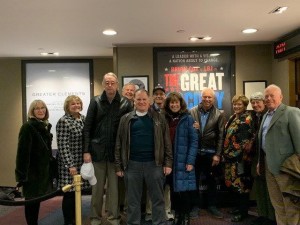
Steve Brown reports: “On Saturday, Nov. 16, a group of 18  ’71 Classmates and friends attended the play “The Great Society’ featuring our own Gordie Clapp as J. Edgar Hoover ( or “J” as referred to by LBJ in the play). Our group consisted of Jock and Anne MacKinnon, Steve and Jorie Latham, Shaye Hester, Rod Brown and Marcia Haydel, Bob and Denise Schwed, John and Louise Finnerty, Jack Sands, Dave and Audrey Kubie,  June and Rob Farnham,  and Sue and I.

 
We all enjoyed lunch at PJ Clarke’s before the play with Gordie and his wife, Elizabeth. It was great seeing Gordie in the play and remembering the years 1964-68. FYI — they did not feature any of Lady Bird Johnson’s visit to Williams College in October, 1967, which is described in our timeline.”


This picture was taken after the play in front of the box office: from left to right, Shaye Hester, Louise and John Finnerty, Steve Latham, Gordie Clapp (a/k/a J. Edgar), Steve and Sue Brown, Jorie Latham, and Jock and Anne MacKinnon.

Jack Nicklaus Didn’t Sleep Here

Paul Lieberman recounts some of the events surrounding Jack Nicklaus’ visit to the Taconic for the 1956 Junior Amateur tournament.


Here’s the back story, as Paul related it during our Fall 2019 Mini-Reunion:

Dave Olson’s Letter to a Graduate

LETTER TO A GRADUATE

JUNE 1971

Young Dave:

Congratulations on reaching this milestone in your life. 

There have been a number of events that you have witnessed in your life to date:

  • Four years on a campus in the rural splendor of NW Massachusetts
  • A great liberal arts education from experienced teachers and not TAs
  • The introduction of co-education at Williams
  • Change to a new 4-1-4 academic year in order to expand opportunities to take courses out of the ordinary
  • A war in Indochina
  • Demonstrations on campus challenging racial equality
  • A vote to close the College to protest the war effort
  • The lack of fraternities (??)

In addition, the last four years were, in many respects, the last extended period where you had the time and opportunity to interact with people with different perspectives in a common environment.  I hope that you took advantage of some, or all, of those opportunities.

But there are many adventures that lie ahead in the next few decades.  Here are things to consider in the years to come.

Personal Issues

  • Find a partner to share your life. From my perspective, that partner should be your intellectual equal and a true individual. Keep in mind that a long-lasting relationship will evolve over time, so factor that into your consideration.
  • If you decide to have a family, spend time with your children as you share the child-rearing duties with your partner. Providing moral direction to the next generation, beginning at a very early stage, is crucial for a successful society.  If you are then blessed with grandchildren, make time for them also.
  • Reflect often on your belief system. But maintain an open mind when you confront the well-reasoned beliefs of others.  Your beliefs can evolve without the loss of your moral compass.
  • Continue to expand your horizons and grow your mind. Learning should be a life-long pursuit
  • Take care of yourself physically and emotionally.

Career and Leadership

  • Now that your collegiate studies are done, you may want to find a First Job to get the experience of actually working. Summer jobs do not count, for people can do just about anything for 9-10 weeks.  I recommend you take such action before you decide on the final path for your life.  That First Job, lasting several years at least, will enable you to develop some skills that may serve you for many years.  You will realize that there are others who are relying on you to do your share of the assigned work.  You need to “show up” and perform; getting a friend’s notes from class is no longer an option or viable solution.
  • If you have the chance, seize any opportunity to become a leader of even a small team of workers. When you try to lead others, you will discover things about your own character as well as the character of others.  Some people need little direction to accomplish a given goal once it is identified.  Some people require constant monitoring to stay on task.  Maybe you will find out which group defines your personal approach to finishing a given task.
  • Find a job (or maybe a series of jobs) that you enjoy performing for your career. Linking your work with something you actually enjoy doing will help you obtain and then maintain emotional equilibrium.
  • Spend the time to develop and hone your job skills. But also remember that few headstones state “Here lies Willie who worked a lot of hours.”  Balance is the key, with the understanding that a pendulum is “in balance” over the long-run but can appear to be out of sync at any given moment.

Social Contribution

  • Find something to do outside of your daily work environment and external to yourself in order to contribute to society. Such activities could be in a wide range of areas such as sport, the arts, faith-based activities, political activities, or something totally different.   Then become involved with the organization in an effort to make it a better place.
  • Share the bounty that you are blessed to receive.
  • Few people truly make it on their own. Become a mentor to someone or a leader of some group.  Most people have help from others along their path of life.  Help maintain the network of the many unnamed mentors and leaders who provide the glue for society.
  • Look for opportunities to impact the lives of others by setting a good example for proper behavior. Others are watching when you are out and about.  Try and maintain a good example on “the important things,” remembering that no one is perfec

General

  • Trust me, you do not need as much “stuff” that you have gathered and will be gathering during your life either alone, with a partner, or with a family. Start curtailing your consumption at an early stage.  You never see a hearse with a carrier hitch pulling a U-Haul.

Good luck on living your own, individual life. 

Maybe I will check in at your 50th reunion.

Older (and wiser?)

David C. Olson

Jamaica Plain, MA

August 2019