
|
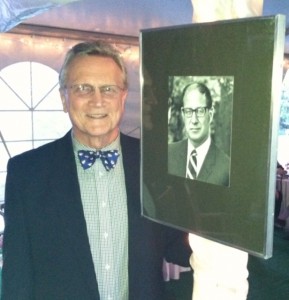
A year after Fred Rudolph’s passing, Dottie followed through on his wish for a springtime “Tulip Party” at their home on Ide Road. Those in attendance included every College President still living, present and past faculty, family, friends and former students – including John Chambers ’71, seen next to Fred’s portrait.
Uncle Fred
Fred Rudolph was, in many ways, an exemplar of the best Williams faculty traditions – teacher as much as scholar, generous mentor as much as gracious gentleman. His influence on me, both personal and professional, still fills me with gratitude, and of course I am but one of countless alumni who would say the same of Uncle Fred, or indeed of so many Williams professors and coaches. Allow me, please, just a bit of testimony in appreciation of my particular gratitude, and another part of his legacy perhaps not so well known.
Arriving at Williams more than fifty years ago from a public high school where I had learned more football than academics, initially intimidated by the sense that everyone I met was better prepared, Fred’s teaching helped me to build confidence. Among the more personal interactions I still recall was a visit to his book-lined office in the old Stetson Library, where he tactfully let me know that my SAT scores were in a realm where confidence was fully deserved, and that my academic career had horizons even beyond Williams. Over the rest of those undergraduate years he was an inspiring instructor of history, and with his beloved Dottie, an island of calm and encouragement amidst the political and social turmoil of the times. Moreover, he and Dottie took Mary (new wife!), Melissa (new baby!) and me into their warm embrace, providing opportunities like house-sitting and looking after their Lisa, that in retrospect were perhaps more invention for us than convenience for them.
All that culminated in an inflection point, when one day at the beginning of senior year, even as I was struggling to imagine next steps for my fledgling family and me, he asked, “Would you be interested in a scholarship for graduate study at Harvard?” Not only a scholarship, it turned out, but another new mentor – Fred’s dissertation advisee at Yale, the “boy dean” at Harvard’s Graduate School of Education, later a leading reformer of American education, Ted Sizer. My professional course was set along a path that carried on the tenets of the Progressive Education movement (first introduced to me in Fred’s classes) through years of public school work as teacher, principal, and then two decades as a school superintendent. All with a gentle nudge and continuing encouragement from Uncle Fred; that nudge also made me, among other things, a very loyal Williams alumnus.
Many a classmate, to be sure, can tell a similar tale of the influence of teachers and coaches, and I hope they will share such stories in these pages. How many of us are thankful for Renzie Lamb, especially just now with news of his passing? Or for Bob Gaudino, whose work inspired an endowment organized in part by members of our class? But there was something unique, too, in what Fred Rudolph was doing. Without fanfare or expectation of thanks, Fred was carrying on a tradition passed to him by a faculty mentor of his own – Charlie Keller. By encouraging interest in pubic schooling, in service as teachers and then perhaps as principals, they were building a cadre of future school leaders that produced, from tiny little Williams, a remarkably disproportionate number of public school superintendents. Some, I know, would testify to the direct influence of Charlie or Fred in their eventual service as superintendents – among them Ernie Fleischman ’59 (Greenwich, CT), Tom Payzant ‘63 (Portland, OR, Boston, MA), Mike McGill ’65 (Mt. Greylock, MA, North Shore and Scarsdale, NY). Many others served in school districts less known, some less fortunate in resources, and perhaps that pleased Fred even more.
All this alongside the older, honored, and better-known traditions of Williams alumni serving in independent schools, or teaching at the college level. The Alumni Directory currently shows hundreds of alums proudly working in K-12 education, both public and private. Encouragement toward such careers is provided by the traditional alumni networks, and now also by the Class of 1959 Program in Teaching, currently directed by Susan Engel. But does the smaller subculture of school superintendents still continue? Only a handful of alums presently show up in the Directory as school superintendents – Hank Bangser ’70 (now in Ojai, CA, formerly in New Trier, IL), Paul Goren ’80 (Evanston/Skokie, IL), and – of particular resonance, since she is the one of the pioneers of Williams coeducation, the sister of Nick ‘71, and spouse of Art ’71 – Rosmarie Tortorello Bovino ’75. (Island Park, NY).
I am unsure whether Fred Rudolph influenced any of the latter three, but I am certain of his legacy in my career, and those of Ernie, Tom, Mike… Quietly, Fred helped build a legacy no less impactful for its tendency to fly below the radar of broad awareness and acclaim. I am also unsure whether Fred ever set foot in a public school, but he surely helped further their mission, thanks to his influence on so many alumni who put a hand to their work.
And yes, he and Dottie touched many lives in personal ways, and (ahem!) gave memorable parties – have you ever seen better swing dancers? Blessings on them both; may others carry on in their footsteps.
John Chambers ‘71
November, 2018